Every Page of Every Page of Moby-Dick, 15

15

9/6/21, 2:12pm

Ishmael is memorably, insufferably reluctant about the prospect of sharing a bed when he finds no private room available at the Spouter Inn. The landlord Coffin suggests he share a bed with a harpooneer, adding that Ishmael ought to be okay with that sort of thing if he’s going a-whaling, and our narrator warily assents to the plan, on condition that there’s nothing “objectionable” about the harpooneer. A bit later, after Coffin teases that the harpooneer is a “‘dark complexioned chap’” who only eats rare steaks, Ishmael’s misgivings grow. Just before reporting his first impression of Bulkington, he seems content to share a bed with the harpooneer on condition that the latter undress and get under the covers first (… ?), but then after the Bulkington business he reveals that he’d hatched another plan already, that is, after the landlord’s “diabolical” innuendos reported prior: to sleep on the hard, knobby bench in the inn’s communal space. Coffin comically accommodates this request for a bit before Ishmael tests the bench, deems it unsuitable, and then starts hatching still other plans for sleeping comfortably at the Spouter Inn. He first entertains a notion of beating the harpooneer to his own reserved room and locking him out of it for the night and only dismisses it owing to the threat of the harpooneer’s presumed vengeance; only then does he consider the possibility that he’s being a bit prejudiced and should meet the man before judging his fitness for a bedfellow.

Another meticulously reported line of pained reasoning occurs during Ishmael’s flip-flopping, just before he tells Coffin that he’d prefer the bench for a bed, which he ends up rejecting. It runs thus:

  1. Point: No one really likes sleeping two to a bed; sub-point: even if the bedfellow is a family member the prospect is undesirable, to say nothing of a complete stranger in an unfamiliar place;
  2. Point: Sailors don’t have to be used to that sort of thing as a rule; sub-point: certain they must share a sleeping quarters, but every man expects to have his own bed (or hammock) and blanket.

MK’s choice of line to illustrate from this page, occupied almost entirely by Ishmael’s self-sophistry about having to share a bed – which concludes by likening sleeping between sheets with another person to sharing a skin – occurs between point and subpoint 1. The canvas is created on another found page from the sewing instruction guide, this one about how to properly cut out pattern pieces. In the lower-left quadrant a partial view of a rectangular bed is outlined in black ink and colored white, except for the blanket which is painted red with orange tubing. The rounded head of a familiar peglike figure is visible sticking out from under the blanket – colored grey with a double-bowed black line stretching across its top for closed eyes, its bisected triangle of a nose half covered by the blanket.

The most striking element of the canvas is the beam of prismed color drawn entering the canvas from the lower third of the far left margin, running directly across it, abutt the head of the peglike figure, and recommencing on the other side of it until this rainbow road meets the edge of the bed, where the individual bands of color – from bottom to top: red, orange, yellow, green, blue, violet, red again – peel off and blossom into a bouquet of shaded natural textures and shapes. The orange and green bands curl downward to form spirals, between which the yellow band expands like a tunnel of light and exits the right margin of the canvas. Hung center canvas is a globular frond suspended like a pendant from the blue band that has shot up on a slight wavy course and bent back. The violet band reaches out toward the edge of the canvas, twisting like a vine. The uppermost red band swells into a compacted wave, and the lowermost red band looks like an outline of this wave spilt upon the sand. Disconnected from the beam of prismed color itself, as if grown out of their blooming on the right side of the canvas, furthest from the sleeping peglike figure in the bed, is a blue shaded gord-shape with a hole in its side out of which grows pair of green tendrils winding their way toward the bottom of the canvas, one of which has produced a palmate leaf.

The illustration evokes serenity and captures the experience of (serenely) dreaming, especially when the sleeping peglike figure is regarded as a sort of everyperson, befitting the generalization Ishmael makes in the line that gives this canvas its title: “people like to be private when they sleep.” Here, perhaps, is the beau ideal of restfulness driving Ishmael’s inexplicable fussiness and indecision about the sleeping accommodations available to him at an inn where he has little to no money to spend. To achieve it, Ishmael thinks, one has to be alone. 

Indeed, this canvas is equally if not more interesting to view as a portrait or self-portrait of Ishmael himself than as an anonymous sleeping everyperson. The beam of prismed light that enters the peghead all neatly composed only to explode into a burst of forms and shapes on the other side, after all, recalls the rainbow road bearing Ishmael’s name that cuts through the jaundiced clouds overhanging the baghead on canvas 1. In spite of all his seeming self possession and self awareness, in Loomings Ishmael gives a slew of sometimes incompatible reasons for going a-whaling: to cure myself, to (not) kill myself, because I have no money, because I have no ties that interest me ashore, because it was fated, and that fate was enforced. His logic is similarly tortured when it comes to sharing a bed.

9:16pm

Ishmael’s train of discourse is less like a rainbow road than a rainbow rail, running simultaneously along not one or even two but a spectrum of lines of thought, each having its own idiomatic hue and flowering into shapes and forms unto themselves. It’s a private sleep indeed – a consummation devoutly to be wished – that can bring all these flowerings into one illustrative composition. Pattern-making helps.

Matt Kish
MOBY-DICK, Page 015

Title: I don’t know how it is, but people like to be private when they are sleeping.
(8.5 inches by 10.5 inches; acrylic paint, colored pencil and ink on found paper; August 19, 2009)
Every Page of Every Page of Moby-Dick, 14

9/5/21, 7:19am

14

Bulkington – Ishmael’s soon-to-be shipmate whose “apotheosis” punctuates the poetic rhapsody marking the Pequod’s passage from harbor to open ocean in The Lee Shore – is first spotted by our narrator in the Spouter Inn. In this canvas MK spots him first spotting this specimen whaleman.

In MD, Bulkington is described as dark complexioned – “face… deeply brown and burnt” – phrasing which has lent support to interpretations of him as dark-skinned by birth and sunbaked by his career asea. Melville’s text does not identify this brief character as Black so unambiguously as those inhabitants of the “negro church” Ishmael trips into and degrades in The Carpet-bag, but if Bulkington is Black, then he’s only the second individual Black person described in their individuality in MD, after the “black Angel of Doom.” In MK’s illustrations, Bulkington’s is the third black face, after the Angel of Doom and the “young fellow” illustrated just prior in 13. 

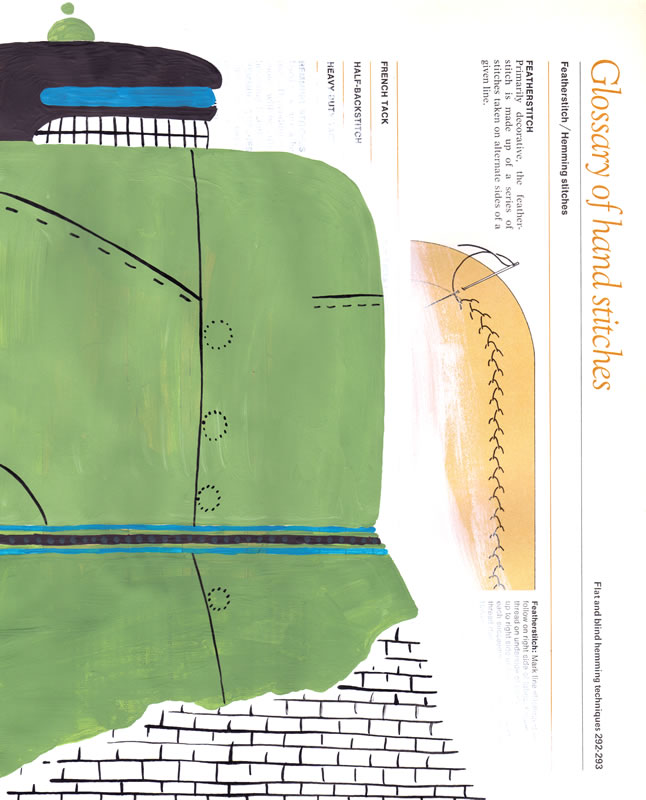
Bulkington’s head – painted small in the upper-left corner of the canvas, facing right, with an undersized, tufted pea green sailor’s cap perched aloft – is not given the elongated peglike appearance of a landsman but appears rather like that shape hammered down to a stump, a brow-like formation overhanging in the silhouette of his face at the base of which another tunnel-like mouth is filled-in with two even rows of shock-white blocks for teeth. The prominence of these teeth is a detail from Ishmael’s description of Bulkington that, notably, does not derive from the titular quote for this canvas; another such detail is reflected in MK’s representation of Bulkington’s eyes as a single elongated band of deep blue, like a helmet’s vizor rendered fluid. In MD, Bulkington’s eyes are described as shadowed, and “floating” in them Ishmael espies “reminiscences that did not seem to bring him [Bulkington] much joy” before he quietly retreats from the raucous society of his fellow, recently-landed shipmates, and they go out into the dark streets hollering after him. In MK’s illustration, Bulkington’s brawn and bulk are given a more enduring presence.

2:17pm

Bulkington’s “coffer-dam” of a chest is the most prominent feature of his physical characterization in this canvas, occupying more than the whole left half of the found page upon which it’s painted: the first sheet of a “Glossary of hand stitches,” rotated 90 degrees right. His pea green monkey jacket – markedly out of proportion to his small, black head – is geometrically shaped with a long sloping corner forming the shoulder, which mimics the contour and placement of the yellow-gold illustration of a featherstitch still visible on the found page just to the right. The billowing visual effect of Bulkington’s jacket is buttressed by two more details of the canvas: 1) the topmost part of the green jacket is painted so as to just overlap the lower row of white teeth, making the figure appear neckless or as if viewed from below, and 2) a waist-belt comprised of a grey-black band sandwiched between two thin lines of blue paint, below which the jacket appears to angle out sharply. Bulkington is swole, but in a fashion rather heavy and static than airy. Indeed, MK adds a feature to the canvas to concretize this bulk: where the found page has been painted over white to accommodate the subject, from below the waving tapered front hem of the monkey jacket, a brick wall extends composed of neatly patterned black lines.

The way MK illustrates him, it would be a wonder for Bulkington to slip from a crowded room unseen, much less to fall into water only to evaporate into thin air. A coffer-dam is a structure designed to enclose and contain great water pressure while submerged. What force, then, could break this body and release the native element therein – brimming just below its surface, as seen by that narrow channel of a vizor-eye – so as to transmogrify it to air? Spoiler: Moby Dick.

Matt Kish
MOBY-DICK, Page 014

Title: He stood a full six feet in height, with noble shoulders, and a chest like a coffer-dam. I have seldom seen such brawn in a man.
(8.5 inches by 10.5 inches; acrylic paint and ink on found paper; August 19, 2009)

Every Page of Every Page of Moby-Dick, 13

13

When Ishmael sits down to a late supper in the frigid Spouter Inn, he and a number of sailors are obliged to button up their coats and hold teacups to their lips to supplement the unwarming glow of two cheap candles upon the table. The inhospitable temperature of the Inn is juxtaposed to the bounty they’re served for the meal: not only meat and potatoes but “dumplings… good heavens! dumplings,” Ishmael reports in that voice designed to replicate the pleasant surprise. A “young fellow” among the huddle at the table sets to eating these dumplings ravenously, prompting landlord Coffin to caution him about disturbing his dreams.

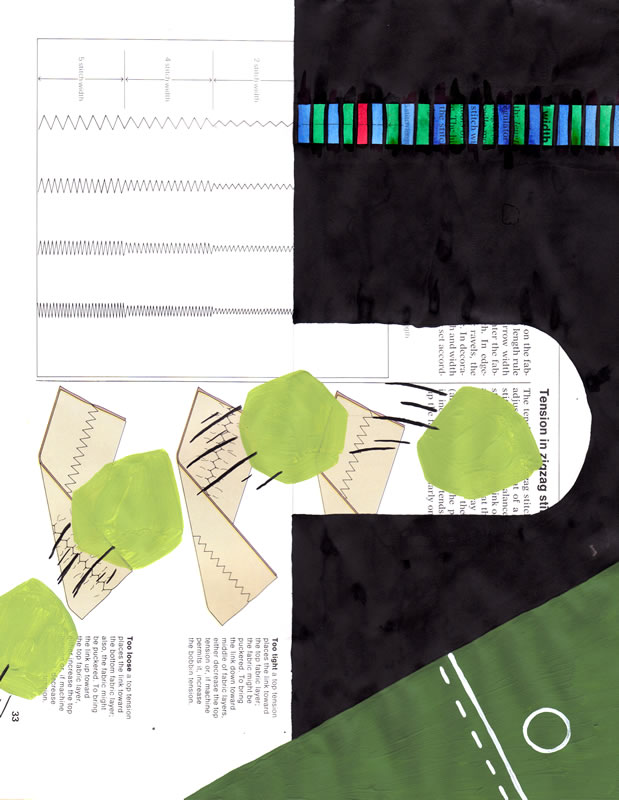
MK illustrates these rapidly consumed dumplings as four roughly formed pea-green balls – evenly spaced apart, each trailed by multiple thin black hash marks depicting motion – arching their way from the lower left corner of the canvas to its middle-right, where some have hurtled into a tunnel shaped into a flat black wall dominating the right side of the canvas. Apart from the context provided by the titular quotation from MD, only two minimal, colored features aid the impression that this is the young fellow’s face the green balls are disappearing into. Overlaying the black form, aligned in the lower-right corner of the canvas, a forest-green triangle is bisected by two parallel white lines (one solid and one dashed, like striping on a two-lane highway) and a white-outlined circle to the right of these lines: the seam and a button of the young fellow’s “box coat.” Near the top of the canvas, a narrow multi-colored balene band extends from one edge of the black wall-like form to the edge of the canvas in alternating blocks of green and blue, save for one block of red so placed as to give the figure a greedy aperture.

This is a relatively simple canvas depicting a simple moment of paternalistic humor in MD, but there are several significant movements happening here in MK’s enterprise (besides the arch of the dumplings): 

  1. The silhouette chosen to represent the face of the young fellow suggests MK interprets this character as a landlubber, since it recalls the peglike form of the water gazers in 2 and the “black Angel of Doom” in 8; this interpretation is supported by the textual detail that the young fellow is dressed in a “box coat” rather than a “monkey jacket” like the sailors at the table wear (and apparently Ishmael, too), which is shorter in length so as not to catch in the wind.
  2. MK’s attentiveness to what the characters are wearing in MD is being advertised by the shift in this canvas of one source of found pages to another. Up to this point every illustration has been created upon a page from a radio systems manual. This illustration is painted on a page from a sewing instruction book, turned on its side. A black-and-white diagram comparing four different types of stitch is left exposed in the upper-left quadrant of the canvas, and about the middle a series of beige illustrations shows the correct way to sew a suture. In fact, MK embraces this series of diagrammed folded seams – from left to right: too loose, too tight, just right – to aid in the effect of the dumplings’ trajectory into the young fellow’s hatch.

10:30pm

  1. We will see a handful more of these peglike figures before the Pequod sets sail, but this is the only remaining form of this type that is imbued with natural elements and textures in a fashion similar to the more prominent seafaring characters MK knows to be shortly arriving to the book. These Elementals will be discussed in their time, but the “young fellow” addressing himself to dumplings in the Spouter Inn is in transitional state, a hybrid figure. He wears the trappings of a landlubber: the box coat and buoy-peg silhouette, but his head is oped to or by the hues of the sea. The natural texture of the balene band that makes a power-stache on the archetypal captain commanding “GET!” (in 4) and a frown upon the geometric face of “the invisible police officer of the fates” that bullied Ishmael into whaling (in 5) serves the young fellow for eyes. A fresh experience asea is to come or perhaps just past, an experience before or behind that of Ishmael, who for his part doesn’t give the young fellow a second passing glance.
  2. The solitary red rectangle interrupting the blue-green pattern of the young fellow’s balene band, placed so as to suggest an eye, provides a clue to interpreting the red eyes of a figure that’s been haunting me – the black Angel of Doom – and one very prominent and important seafaring character MK knows to be shortly arriving to the Spouter Inn (and into MD), who is nearly always illustrated with red, pointilated pupils for eyes like those staring out of the canvas in 8 – Queequeg. In MK’s illustrations red eyes betoken a character in extremity: for the young fellow, his extremity is simple, albeit voracious hunger (“Whatcha doing?” “Eating!”). The extremity of the “black Angel of Doom” is harder to articulate, being that of a whole individual life in extreme which also shoulders the extremeness of a whole people in extremity, striving to acknowledge each of those individual extremities, and delivering them all faith. The single red hungry eye of this young fellow calls me to look back with a more sensitive and sympathetic eye on MK’s “black Angel of Doom” and quickens my anticipation of eyes I know to be awaiting me ahead.

This canvas made out of a page about how to sew sutures is itself a suture. In lightheartedly illustrating the direful manner in which this young fellow addressed himself to dumplings, MK had his own lee shore.

Matt Kish
MOBY-DICK, Page 013

Title: One young fellow in a green box coat, addressed himself to these dumplings in a most direful manner.
(8.5 inches by 10.5 inches; acrylic paint and ink on found paper; August 18, 2009)

Every Page of Every Page of Moby-Dick, 12

12

8:14pm

I’ve sometimes drank as if to race death to the bottom of a glass, but I’ve also witnessed people drinking themselves as if literally to death. I’ll never forget the young man I saw running shirtless, full sprint, bent-waisted and headlong into the wooden railing of the porch of the mountain house where we were partying – repeatedly, ramming his head into the railing – nearly knocking himself out with every sickening crunch of the very top of his head against the well-fastened, not widely spaced balustrade, until he keeled over vomiting in the liriope and rhododendron. His friends said he was just drunk and always like that. We took him to the ER after seeing some worrisome evidence in his vomit, and he ended up having his stomach pumped. I laid off substances for some days, life went on, I graduated college, and I’m still no teetotaler. I’m drinking right now…

And what about how the gerund “drinking” can mean specifically drinking alcohol and be regarded as a straight-faced stand-in for drinking no other substance or elixir? “Whatcha doing?” I’m drinking. By that I surely cannot mean I am drinking milk, orange juice, tea, or water. Of course, I may be drinking any of those drinks and say “I’m drinking.” when asked what I’m doing, but even if it went like this – “Whatcha doing?” “Drinking.” “This early??” “Drinking coffee.” “Oh right [lol, eyeroll]” – it would be a bad joke, cheap sarcasm. One says “I’m drinking.” as if it could possibly mean, when asked “Whatcha doing?” and I say “Eating.” that I could only mean myself to be eating one type of food, or idly joking about not eating that one type of food. I’m drinking…

Drinking… For some it’s an easy compromise, for others an uneasy one, and for some it’s a disease. Whatever ease you have or lack or perpetually undo when it comes to drinking you’re reminded looking at this canvas that death is at the bottom of it. Language itself propels us toward a death’s head at the bottom of an empty, heavy bottomed glass, where was the fiery brew we would pour down the hatch as if to put out the deadly flame down below, or just behind.

9/3/21, 6:02am

The temperance movement biases Ishmael’s description of the bar at the Spouter Inn to no small degree. The barman, “another cursed Jonah,” sells sailors “delirium and death” from his jawbone den and at cheating prices. In contrast to the motley store of flasks, bottles, and decanters that house the “poison,” his customers drink from glasses that are “true cylinders” where they meet the hand and “tapered” where they hold their measures. MK honors this feature of the barman Jonah’s deceptive drinkware with his illustration of an empty glass – painted lightly in a “villainous” shade of green, set center-canvas against a backdrop of flowering flames, orange overlaid yellow. A jawless skull rests atilt in the narrowed false-bottom of the glass, not drawn but collaged into the canvas, adding a glaring realism to the otherwise simple illustration.

A basic, small tri-pointed crown, colored yellow, floats above the rim of the glass aligned with the sunken death’s head below, the only detail of the illustration that lacks an obvious analogue in the text of MD. Ishmael never ventures closer to the robber Jonah’s den than to note that you could park a carriage in there (cramped as the rest of the place is made out to be), so he never opines what royal distinction may apotheosize from a drained, abominable tumbler.

Matt Kish
MOBY-DICK, Page 012

Title: Abominable are the tumblers into which he pours his poison.
(7.25 inches by 11 inches; acrylic paint, collage and ink on found paper; August 17, 2009)

Every Page of Every Page of Moby-Dick, 11

9/2/21, 12:49pm

11

After his contemplation of the beguiling painting that hangs to one side of the entryway to the Spouter Inn, Ishmael turns to regard some “storied” retired tools of the trade the landlord Coffin has on display on the opposite wall. One of these implements is a lance reputedly wielded by one Nathan Swain to “kill fifteen whales between a sunrise and sunset” some fifty years prior (it’s said) to Ishmael’s visit to the Inn. 

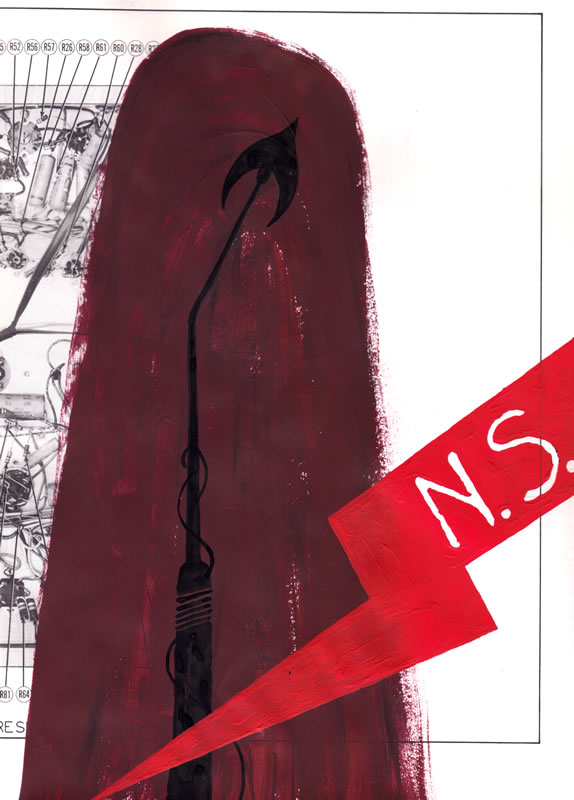
MK illustrates this lance – oriented vertically, just left of center canvas – with a marked realism: the head of the lance is spade-shaped and set atop a thinly tapered rod, which at a length about six times that of the height of the lancehead is bored into a thick rounded handle, complete with a handgrip and a stray span of whale-line corded haphazardly about the tool and dropped dangling out the bottom of the frame. The lance is painted in silhouette, all black, and cut off by the bottom edge of the canvas at about half the length of what the handle would measure in life. Apropos Ishmael’s description of this lance as “wildly elbowed,” the rod to which the lancehead is affixed is angled stiffly to the right at about a 40 degree angle relative to the vertical axis of the canvas, putting the diverted lancehead center-canvas in the upper third of the found page.

Most of the circuitry schematic that would be visible on the left hand side of this sheet is obscured by a crudely painted, dark ruddy backdrop to the lance, unevenly rounded off at the top and broader at its base; the blunted shape and coloring of this feature lends a stillness and deadness to the appearance of the lance that it might otherwise lack. The bent implement appears closeted in the redbrown cavity or rather embossed black on the face of a muddied, titled tombstone. 

Movement and dynamism is brought to the canvas not by the bend in the retired lance but by the hot candy-red lightning-bolt entering the foreground of the illustration from the middle-right and extending to its lower-left extremity. The initials “N.S.” appear prominently on the broadest span of the red lightning-bolt on the far right side of the canvas, slightly askew. The effect is that of a flashing tag or pennant announcing that it’s the supposed “honor and glory” of Nat Swain that quickens Ishmael’s (and, in turn, MK’s) attention to this relic, more than the lance itself.

It would be very like Ishmael to say that this “‘once […] bravest boat-header out of all Nantucket’” inked his name to the beadroll of the immortal fishery in the blood of his monstrous foe (that is, before he “‘joined the meeting’” and got worried about his “‘plaguy soul,’” as Capt. Peleg later recalls Swain’s conversion to Quakerism and pacifism). MK is more sensitive and (perhaps like Swain) more attuned to the living legacy of all this bloodshed than the number of dead whales in one day that it happened to dart from. In his illustration, the initials N.S. aren’t written in the hot red flash but carved out of it as it were, nothing in themselves: an emptiness made legible by what surrounds it.

Matt Kish
MOBY-DICK, Page 011

Title: With this once long lance, now wildly elbowed, fifty years ago did Nathan Swain kill fifteen whales between a sunrise and a sunset.
(7.75 inches by 11 inches; acrylic paint and ink on found paper; August 13, 2009)

Every Page of Every Page of Moby-Dick, 10

8/27/21 / 8/31/21

6:46am / 6:28am

10

Another collage: a found page showing an aerial view of a circuitry schematic plays host to a brow-shaped, blurry-edged mass painted black in the middle of the vertical rectangular diagram. Below this mass are three vertical, roughly formed strokes of deep blue paint. A cut-out of an ovular black frame with white matting strip has been glued on the page to surround this scene. Below the frame, occupying the bottomost edge of the canvas, a series of 3 images show a white silhouetted hand against a black background with its index finger extended, touching a ribboned band of white, which becomes more visibly pronounced – more pronouncedly white that is – with each successive image, as if emanating from the point where the finger makes contact. 

MD features a bizarre admixture of narrative styles and voices that tells us to call it by one name. One of the many eccentricities of this queer legion is its tendency to describe scenes without the benefit of context but in the surprised, confused, disordered, even frightening way in which many experiences are first witnessed. This is the case for the painting Ishmael notices hanging on the wall when he first enters the Spouter Inn. At first he can’t make out the subject: whether owing to the smoky, oily environs of the inn itself and its cumulative effect on the canvas or the quality of the painting itself is difficult to tell. MK’s choice of line to illustrate from this page reveals his interest and investment in not the contextualized, objective revelation of what the painting represents but Ishmael’s attempt to describe it for the reader before this moment of recognition has occurred. The series of collaged images illustrating a fingertip’s touch seems to me an attempt to capture this process of capturing the image, or rather to preserve its not being captured, since neither the title of the piece (the line from MD) nor the collage itself permits knowledge of the painting’s ‘true’ subject (the one Ishmael eventually ‘theorizes’ based on the aggregated wisdom of many learned men he consults on the subject).

A detail of this canvas which is only barely visible in MK’s original scan of this illustration and does not register in the image that appears in Moby-Dick in Pictures: are four lightly-painted patches of pinkish tan which extend from the edges of the collaged frame roughly at the intercardinal  points of the canvas’s perpendicular axes – the “nameless yeast,” perhaps, rendered only to be sometimes lost to view.

Matt Kish
MOBY-DICK, Page 010

Title: But what most puzzled and confounded you was a long, limber, portentous, black mass of something hovering in the centre of the picture over three blue, dim, perpendicular lines floating in a nameless yeast.
(7.75 inches by 11 inches; acrylic paint and collage on found paper; August 13, 2009)