Every Page of Every Page of Moby-Dick, 8

8

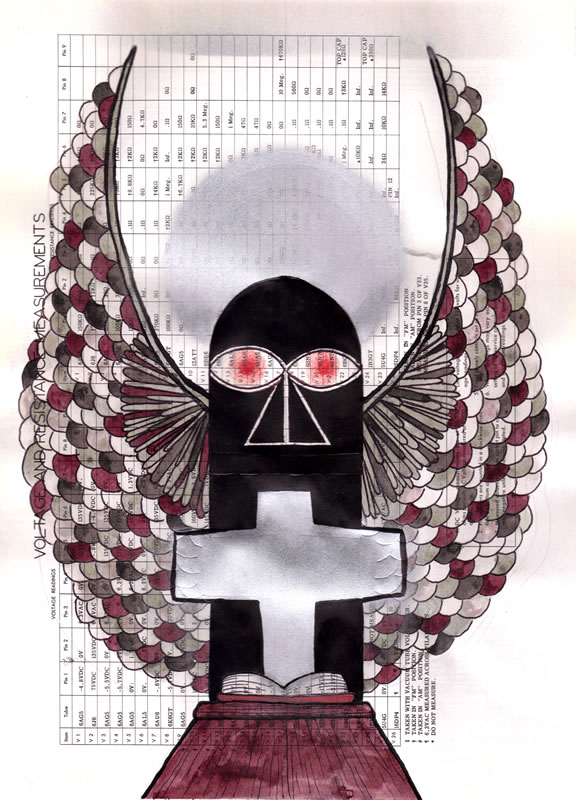
The peglike buoy figure of the water gazers in 2 returns in MK’s rendering of the “black Angel of Doom” Ishmael witnesses “beating a book” before a congregation in the “negro church” whose service he rudely interrupts then cruelly mocks before eventually finding his proper place at the Spouter Inn in New Bedford. The water gazers in 2 appear sexless and featureless apart from their beaky noses, hazy grey eyes, and multi-colored, -patterned wrappings. This canvas suggests that the figures are racialized, as this one is painted jet flat black from its smooth rounded head to the point where its tubular body vanishes behind a small brown pulpit uplifting a small book. The hazy, pointilated eyes are red, and a pair of large wings extend lifted from its sides, composed mostly of neatly layered small scallop shapes colored in various shades of maroon, grey, pink, black, and white (The wings have another texture where they meet the figure’s body: long slender U-shaped forms are colored in various shades of grey and black). A light, metallic grey spray-painted cross appears afront the black figure and a likewise painted nimbus crowns its head, framed between the uplifted wings.

The peglike figures seem to be MK’s answer to rendering the nameless landlubbers who populate the early pages of MD. This one is given prominence as the sole occupant of the canvas and by its great wings, but its most distinguishing and important feature is the one that differentiates it from the water gazers in 2: its blackness. Ishmael’s attitude (mock-revolted, dismissive) toward the congregation and pastor at the Black church is far from generous – indeed it’s dehumanizing – and MK chooses his moment on this cringeworthy page of MD to wrest some compromise between what Ishmael reports seeing and what he sees Ishmael seeing. Such compromises are fraught under the weight of US history. I’m anxious to witness how and where he chooses to grapple with illustrating Ishmael’s (and Melville’s) often racist characterizations of Black persons especially as the book goes on, having only begun myself with this “Angel of Doom” to sense the burden of (ir)responsibility that follows hard upon returning them into words. What is “doing justice” to a book like this, when it’s an injustice to some?

On the very edges of broad horizontal arms of the cross, where they extend past the tubular black body, you can make out traces of the scalloped lines composing the Angel’s wings beneath: a clue to the order in which the elements were created to compose this canvas – a detail I love.
Matt Kish
MOBY-DICK, Page 008

Title: …and beyond, a black Angel of Doom was beating a book in a pulpit.
(7.75 inches by 11 inches; ballpoint pen, colored pencil, ink and spray paint on found paper; August 13, 2009)

Every Page of Every Page of Moby-Dick, 7

8/24/21

1:11pm

7

First collage of the book, by virtue of yellowish green, rectangular cartoon affixed to the bottom of the found page (finally figured out from the printing on this page that the book being repurposed for these canvases is a systems manual for a Philco Chassis radio). The cartoon shows a man with his hand glued to a cabinet or window with another person (maybe a woman) behind, grasping his shoulders, trying to help him pry it off, the glue stretching between the man’s palm and the object’s surface: he appears panicked and pained, both appear strained. The cartoon forms a kind of band across the wrist of a rudimentary hand outlined with a medium-thick black pencil line, shaded grey, which occupies the majority of the canvas. Three irregular splotches of silver spray paint are added to the center of the canvas, representing the “few silver pieces” Ishmael retrieves from his pocket as he considers lodging options upon first arriving to wintry, tempestuous New Bedford.

Without the cartoon, the painting would register as a rather literal rendering of this page of MD compared to the canvases that have come before. The comical image of the man in a sticky situation belies the seriousness of Ishmael’s predicament – arriving to an unfamiliar place after nightfall with “little to no money in [his] purse” and facing a icy, restless night on the city street unless he finds shelter soon – but this is precisely the aptness of the collage. For all his vulnerability upon arriving to New Bedford, Ishmael casually, jokingly, even mockingly surveys his prospects before finally finding hospitality in the Spouter Inn.

MK’s illustrations are keenly attentive to the humor of MD; his choice of line often reveals his attraction to it. The line from the book that inspired this illustration is not the most overly funny line in the book up to this point, but this is one of the first overtly comical illustrations owing mainly to the element of collage.

Matt Kish
MOBY-DICK, Page 007

Title: With anxious grapnels I had sounded my pocket, and only brought up a few pieces of silver…
(7.75 inches by 11 inches; collage, colored pencil and spray paint on found paper; August 12, 2009)

Every Page of Every Page of Moby-Dick, 6

6

10:21pm

Another found page is painted over almost entirely by a rectangular field of deep azure, saturating the canvas. Only on the left and right margins (about a fingernail’s width on each side) does any of the circuit board schematic show through, and there only a series of partial small circles containing alphanumeric labels for the resistors being identified on the schematic buried in the blue. At the bottom of the canvas two fin-shaped protuberances, angled down, reveal the big blue block to be the form of “the great whale” swimming up the page.

A narrow inverted V painted white dominates the middle third of the canvas. Regarded two dimensionally this inverted V – tapered toward the lowermost points and of greater breadth at the fulcrum – appears to have some symbolic investiture, like a great white phallic hieroglyph on the great blue whale’s back, which befits the line from MD that inspired this illustration, where “the overwhelming idea of the great whale…” is gendered (generically) male: “…himself.” It calls to mind a primitive blade, archetype of the harpoons and lances by which legions of real whales were slain in the fishery. 

Now refocus your gaze three dimensionally. You’re not looking down on this “overwhelming idea of the great whale” from above. This very form of whale, the “chief motive” of Ishmael going a-whaling, you’re seeing from below. That empty inverted V is a yawn, her opening maw.

Matt Kish
MOBY-DICK, Page 006

Title: Chief among these motives was the overwhelming idea of the great whale himself.
(7.5 inches by 11 inches; acrylic paint on found paper; August 11, 2009)

Every Page of Every Page of Moby-Dick, 5

5

8:47pm

An admixture of geometric shapes and natural forms, textures, and colors comprise the body of “the invisible police officer of the Fates,” who in Ishmael’s dramatization decided his decision to go a-whaling. (Remember, that celestial script that predestined the whaling voyage of one Ishmael to fall somewhere between a hotly contested Presidential election and a bloody war in Afghanistan?) A pair of large, uplifted wings, comprised of long, pointed feathers – uncolored, outlined black – are set aback a body of geometric forms: a circle superimposed on a triangle, the apparent head, atop a rectangle turned on end. The circle is grass green and the triangle, almost entirely eclipsed, sunlight yellow; over the parallelogram of a body black ink and grass green unmix in thick, fluid swirls. 

Across that suntipped green circular field of a face runs a thin baleen band – a chain of tiny white rectangles forming a Venetian blind of a frown – below two staring eyes. One of them is one and the other is three, a triad of white points outlined black. The natural textures and stark two dimensional shapes of this canvas converge or collide in the appendages: two mechanistic arms fisted with metallic grey cubes for hands and, in a matching shade, two delicate feet like angled skyscrapers viewed from afar detached from the rest of the body.

Every time I look at this figure I’m drawn first to that geometric green face, placed almost dead center of the canvas. Then those scoping eyes or that wide drawn frown avert my gaze to either side, where a wrecking block hand is suddenly now just in view, coming from below. Scanning for a path of escape, my eyes have one last peaceful view of those angelic disembodied feet jackknifed like buildings against the sky before I turn the page. Traditionally, if hoping to espy angels, one keeps the chin up; this one drives mine down: a heavenly bully.

Matt Kish
MOBY-DICK, Page 005

Title: …this, the invisible police officer of the Fates, who has the constant surveillance of me, and secretly dogs me, and influences me in some unaccountable way…
(7.75 inches by 11 inches; acrylic paint and ink on found paper; August 9, 2009)

Every Page of Every Page of Moby-Dick, 4

4

In Loomings Ishmael comically downplays the affront of being ordered “to get a broom and sweep down the decks” by “some old hunks of a sea captain” (“What of it…?”), whereas MK comically exaggerates the violence of the hierarchy comprising the society of the whaleship.

“GET” is painted in large, blocked black letters on the bottom left of the canvas (found paper still, a chart of “resistance measurements”), as if rained down from an agape, inhuman mouth with a thin pink lip, by virtue of a field of long slantwise squiggly black lines interspersed pink and blue. The command emanates from a weirdly drawn hooked, bulbous figure occupying the majority of the right side of the canvas. The topmost portion of this figure is painted black, and below that it’s bedaubed mostly gray, except for an arching horizontal row of vertical rectangles colored alternately light blue and pink, with two odd yellow ones breaking up the pattern. 

7:21pm

Atop this de-anthropomorphic head, a little black hump serves for a hat; shown in profile, its one beady blue eye affixes to nothing if not the emblematic white anchor, ringed shieldlike in alternating blocks colored yellow and red and projected spoutwise ahead of the faceless face. It’s the very power structure of the whaleship personified, and therefore properly depersonified: a zoomorphic right whale of a captain, a band of baleen flashing in the sun and all.

Matt Kish
MOBY-DICK, Page 004

Title: What of it, if some old hunks of a sea captain orders me to get a broom and sweep down the decks?
(7.75 inches by 11 inches; acrylic paint, highlighter marker and ink on found paper; August 8, 2009)

Every Page of Every Page of Moby-Dick, 3

11:45am

3

A student once glossed “the ungraspable phantom of life” Ishmael refers to in Loomings as “happiness.” She wasn’t wrong, but I’m much more convinced by MK’s rendering of this line: a gaping or gasping spermatozoon, pen-lined in black-blue ink with unibrow, asymmetrical eyes, and short carrot-crop atop its head. It’s encased in a spherical shape, a periphery shaded sky blue. The sphere recalls the delicate, floating, semi-translucent ovum we’re so accustomed to seeing in microscopically framed videos of human fertilization, where spermatozoa dart toward and chew their ways spasmodically and violently into the egg. MK puts the little boundary breaker in its place, an egg of its own from which to hatch, or not to hatch. MK’s wriggler isn’t confined serenely as an embryo or fetus in the womb but appears rather seized – entombed – the environment where it may freely drink or breathe seemingly outside not inside its bubble. And the possibility of the bubble’s own movement or imminent breakage is arrested, too, by faint sage painted triangles of various sizes extending at various angles toward the bubble’s periphery from the edges of the canvas.  

Whereas in the framing of the fertilization vids the sperm vanish, loose themselves – utterly, seemingly – in reaching their destination, MK’s wriggler appears desperate, choking to be free, the same key that would open the prison to free it unlocking death. It’s life-death artificially arrested: the case of M. Valdemar reduced to a single, silenced whiplike sperm rather than a engorged, lolling tongue repeatedly avowing it’s dead.

Matt Kish
MOBY-DICK, Page 003

Title: It is the image of the ungraspable phantom of life; and this is the key to it all.
(7.75 inches by 11 inches; acrylic paint, ballpoint pen and colored pencil on found paper; August 7, 2009)

Every Page of Every Page of Moby-Dick, 2

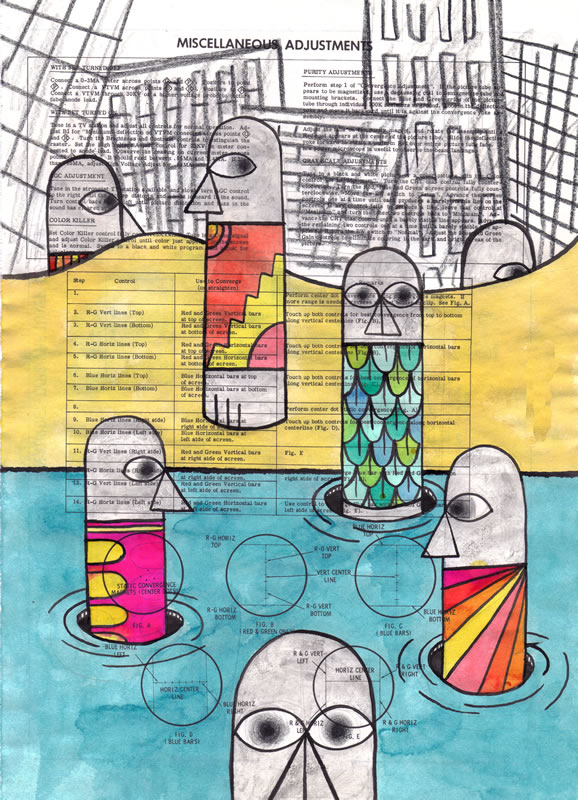
It’s a shoreline scene. Rudimentary gray outlines of storied buildings grow up slantwise beyond the rolling, yellow bank. The “water gazers” described in Loomings are painted as grey limbless cylinders, bald and rounded at the top, with beaky noses and lidless dilated eyes, their faces pointing in every direction but toward the geometric structures in the background. Some behind the rolling yellow shoreline peek over the vales, others stand erect near the black line forming the shore between ochre yellow and opaline blue – facing every which way, waterward all they stare, toward the vantage of the viewer of the canvas. One of them – the foremost, with only the top of its head shot above the bottom of the frame – faces me directly, blankly, like a photobomb. Variously patterned and colored, some of the figures appear partially submerged but still shooting up out of blue as if through a wormhole, never quite in touch with that native element they’re so drawn to.

The city folk Ishmael espies trapped in “ocean reveries” as an escape from their daily lives confined in lath and plaster, chained to desks, while drawn to the water for reasons akin to those of the renegades, castaways, and meanest mariners aboard the Pequod are not in MK’s illustrations imbued with the element as other characters are – or traversed by it, opened to it – but rather insulated from it, dried out from want of it. No lids for their eyes because no moisture to quicken there, much less a tear to spare. They’re like buoys: still made for the water but only what they are so long as they keep it out.

MK’s choice of line here shows his partiality to MD’s humor. While the illustration isn’t unfunny, it repels me like an unwanted glimpse in a mirror. My sister, a sailor, would probably laugh more freely at it. I guess it comes down to how honestly you can occupy the vantage the canvas casts you in.

Matt Kish
MOBY-DICK, Page 002

Title: But look! here come more crowds, pacing straight for the water, and seemingly bound for a dive.
(7.75 inches by 11 inches; colored pencil and ink on found paper; August 6, 2009)

Every Page of Every page of Moby-Dick, 1

8/22/21, 8:14am

1

In “Loomings” the narrator we’re told to call Ishmael makes himself known to the reader obliquely. Between the lines as it were, we learn that Ishmael is a former schoolmaster, steeped in the Classics, who perennially gets so “hazy about the mouth” to go asea to alleviate his “spleen”: to avoid doing a-harm to others or to himself, his “substitute for pistol and ball.” 

In MK’s first rendering of the narrative apparatus or conceit of Moby-Dick the name Ishmael appears atop the page of “found paper” drawn in blocked capital letters, outlined with thick black strokes. The original printing of some circuitry manual is still legible beneath the painting, revealing that the name “ISHMAEL” isn’t painted on but rather merely formed as a preserved space of the canvas, projected as if on a screen – or perhaps as the screen itself – by a beam of prismed light parting a cloud formation, jaundiced as if backlit by the sun. A figure of Ishmael that will recur throughout MK’s MD as a major motif appears painted large in the lower-right quadrant of the page: the shape is vaguely head-like with two blue, glaring eyes spaced widely apart. The upper portion of the head-like shape is bedaubed grey and the lower portion of the figure is blue, the line between these two hues drawn as two peaking waves that give the head-like shape a sort of grimacing expression to my eyes.

Since “Loomings” is composed mostly as a poetic meditation on the magnetic virtues of water – the most abundant substance on Earth: at once the most vital of its life-giving elements and its most destructive force – it’s fitting that MK first renders Ishmael as a sort of baghead, tied off neatly at the top, half filled with the stuff. Ishmael’s head looks to me like the sack of water a child would be seen carrying away from a fair as a prize, only this bag has eyes and no fish inside.

Matt Kish
MOBY-DICK, Page 001

Title: Call me Ishmael.
(8.5 inches by 11 inches; colored pencil and ink on found paper; August 5, 2009)

Every page of Every Page of Moby-Dick

Dedicated to Matt Kish

By Seth Wood

Experiment commenced: August 2021

I first encountered the art of Matt Kish by coming across Moby-Dick in Pictures (Tin House, 2011) on a bookstore shelf and was immediately captivated by it. I had been struggling with my own relationship to Melville’s Moby-Dick, or the Whale. As an aspiring scholar of American literature I knew I had to contend with it. As a graduate student instructor I told one of my first audiences of students that “Poe [was] my ocean [the ocean I was castaway upon, honestly], and Moby-Dick [was] my mountain.” It was a mountain which I couldn’t say honestly I’d climbed until after I saw it through the lens of Matt Kish’s illustrations (and at first with no little help from Frank Muller’s masterful reading of the book, too, I’ll admit). 

Within a year of finding Moby-Dick in Pictures I was presented with my first opportunity to teach an American literature course as a post-graduate with a doctorate at Oklahoma State University. I decided to teach Moby-Dick and that Matt Kish’s art would be involved, but I little expected how the events of that year would bring me into a much more personal and profound connection to his work. I’m sure those events will be referred to in the pages to come, so leave it… keep it simple as he did getting underway (as it turns out, 12 years ago this month).

Because I consider Matt Kish’s project of creating an original illustration for every page of Moby-Dick to be one of the greatest interpretations of the book ever made, I am now going to write a page (or thereabouts) for every one of his 552 (or thereabouts) illustrations. Any references or quotes of Moby-Dick that are made are done from memory, unless referencing the individual lines from Melville’s book with which MK titles his illustrations. 

Here is the first page: 

8/19/21, noonish

First lines are trouble. In Moby-Dick that trouble is at least double. What is the first line of the book anyway? Ask anyone who knows anything about it, and they’ll know: “Call me Ishmael.” – like the bartender who recently overheard me lording some knowledge of the book myself and declaimed the sentence aloud to the nearly deserted bar. It’s the book’s famous first line, maybe one of the most famous first lines of all time, but is that the book’s first line? Even after the customary front matter of the title page and dedication to Hawthorne, after the Table of Contents, the first word is “Etymology” (no punctuation) then that odd little bit about the “pale,” “consumptive,” “threadbare” Usher/grammarian, and then there’s the catalogue of “Extracts,” decontextualized words on whales from a sort of greatest hits of Western civilization (with a few notable exceptions).

But MK draws none of these pages at first*, set awkwardly and strangely between the Table of Contents and Loomings, paginated with Roman numerals. It’s not how he sees it, not at the time of commencing his experiment anyway. By the time I hit Chapter 1, the warp is already mounted on the loom.

*In 2015, 4 years after completing his “task,” MK composed a series of illustrations of the Extracts that can be viewed on his website here.

Glossary update: Basilosaurus

Relating to our last blog post “‘Walking Whales’ in the Wadi Al-Hitan,” touching on the ancient evolutionary predecessors of modern whales, we’ve updated our Glossary to reflect on the reference to the Basilosaurus (aka Zeuglodon, Hydrarchos) fossil unearthed in America in the mid-nineteenth century, embedded in the following passage from Chapter 104 of Moby-Dick, “The Fossil Whale”:

But by far the most wonderful of all cetacean relics was the almost complete vast skeleton of an extinct monster, found in the year 1842, on the plantation of Judge Creagh, in Alabama. The awe-stricken credulous slaves in the vicinity took it for the bones of the fallen angels. The Alabama doctors declared it a huge reptile, and bestowed upon it the name of Basilosaurus. But some specimen bones of it being taken across the sea to Owen, the English Anatomist, it turned out that the alleged reptile was a whale, though of a departed species. A significant illustration of the face, again and again, repeated in this book, the the skeleton of a whale furnishes but little clue to the shape of his fully invested body. So Owen rechristened the monster Zeuglodon; and in his paper read before the London Geological Society, pronounced it, in substance, one of the most extraordinary creatures which the mutations of the globe have blotted out of existence.

Ishmael’s report on the curious history of this “most wonderful of all cetacean relics” is not the most accurate, so we invite you to read the fruits of our research on the subject here.

BasilosaurusSketch.jpg

“Sketch of a Basilosaurus skeleton.” Image credit: Smithsonian Institute, National Museum of Natural History