Every Page of Every Page of Moby-Dick, 12

12

8:14pm

I’ve sometimes drank as if to race death to the bottom of a glass, but I’ve also witnessed people drinking themselves as if literally to death. I’ll never forget the young man I saw running shirtless, full sprint, bent-waisted and headlong into the wooden railing of the porch of the mountain house where we were partying – repeatedly, ramming his head into the railing – nearly knocking himself out with every sickening crunch of the very top of his head against the well-fastened, not widely spaced balustrade, until he keeled over vomiting in the liriope and rhododendron. His friends said he was just drunk and always like that. We took him to the ER after seeing some worrisome evidence in his vomit, and he ended up having his stomach pumped. I laid off substances for some days, life went on, I graduated college, and I’m still no teetotaler. I’m drinking right now…

And what about how the gerund “drinking” can mean specifically drinking alcohol and be regarded as a straight-faced stand-in for drinking no other substance or elixir? “Whatcha doing?” I’m drinking. By that I surely cannot mean I am drinking milk, orange juice, tea, or water. Of course, I may be drinking any of those drinks and say “I’m drinking.” when asked what I’m doing, but even if it went like this – “Whatcha doing?” “Drinking.” “This early??” “Drinking coffee.” “Oh right [lol, eyeroll]” – it would be a bad joke, cheap sarcasm. One says “I’m drinking.” as if it could possibly mean, when asked “Whatcha doing?” and I say “Eating.” that I could only mean myself to be eating one type of food, or idly joking about not eating that one type of food. I’m drinking…

Drinking… For some it’s an easy compromise, for others an uneasy one, and for some it’s a disease. Whatever ease you have or lack or perpetually undo when it comes to drinking you’re reminded looking at this canvas that death is at the bottom of it. Language itself propels us toward a death’s head at the bottom of an empty, heavy bottomed glass, where was the fiery brew we would pour down the hatch as if to put out the deadly flame down below, or just behind.

9/3/21, 6:02am

The temperance movement biases Ishmael’s description of the bar at the Spouter Inn to no small degree. The barman, “another cursed Jonah,” sells sailors “delirium and death” from his jawbone den and at cheating prices. In contrast to the motley store of flasks, bottles, and decanters that house the “poison,” his customers drink from glasses that are “true cylinders” where they meet the hand and “tapered” where they hold their measures. MK honors this feature of the barman Jonah’s deceptive drinkware with his illustration of an empty glass – painted lightly in a “villainous” shade of green, set center-canvas against a backdrop of flowering flames, orange overlaid yellow. A jawless skull rests atilt in the narrowed false-bottom of the glass, not drawn but collaged into the canvas, adding a glaring realism to the otherwise simple illustration.

A basic, small tri-pointed crown, colored yellow, floats above the rim of the glass aligned with the sunken death’s head below, the only detail of the illustration that lacks an obvious analogue in the text of MD. Ishmael never ventures closer to the robber Jonah’s den than to note that you could park a carriage in there (cramped as the rest of the place is made out to be), so he never opines what royal distinction may apotheosize from a drained, abominable tumbler.

Matt Kish
MOBY-DICK, Page 012

Title: Abominable are the tumblers into which he pours his poison.
(7.25 inches by 11 inches; acrylic paint, collage and ink on found paper; August 17, 2009)
Every Page of Every Page of Moby-Dick, 11

9/2/21, 12:49pm

11

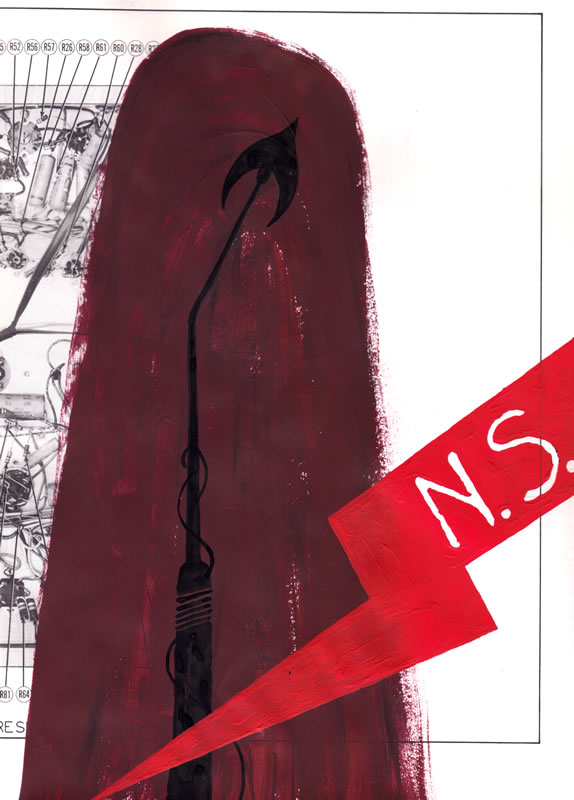
After his contemplation of the beguiling painting that hangs to one side of the entryway to the Spouter Inn, Ishmael turns to regard some “storied” retired tools of the trade the landlord Coffin has on display on the opposite wall. One of these implements is a lance reputedly wielded by one Nathan Swain to “kill fifteen whales between a sunrise and sunset” some fifty years prior (it’s said) to Ishmael’s visit to the Inn. 

MK illustrates this lance – oriented vertically, just left of center canvas – with a marked realism: the head of the lance is spade-shaped and set atop a thinly tapered rod, which at a length about six times that of the height of the lancehead is bored into a thick rounded handle, complete with a handgrip and a stray span of whale-line corded haphazardly about the tool and dropped dangling out the bottom of the frame. The lance is painted in silhouette, all black, and cut off by the bottom edge of the canvas at about half the length of what the handle would measure in life. Apropos Ishmael’s description of this lance as “wildly elbowed,” the rod to which the lancehead is affixed is angled stiffly to the right at about a 40 degree angle relative to the vertical axis of the canvas, putting the diverted lancehead center-canvas in the upper third of the found page.

Most of the circuitry schematic that would be visible on the left hand side of this sheet is obscured by a crudely painted, dark ruddy backdrop to the lance, unevenly rounded off at the top and broader at its base; the blunted shape and coloring of this feature lends a stillness and deadness to the appearance of the lance that it might otherwise lack. The bent implement appears closeted in the redbrown cavity or rather embossed black on the face of a muddied, titled tombstone. 

Movement and dynamism is brought to the canvas not by the bend in the retired lance but by the hot candy-red lightning-bolt entering the foreground of the illustration from the middle-right and extending to its lower-left extremity. The initials “N.S.” appear prominently on the broadest span of the red lightning-bolt on the far right side of the canvas, slightly askew. The effect is that of a flashing tag or pennant announcing that it’s the supposed “honor and glory” of Nat Swain that quickens Ishmael’s (and, in turn, MK’s) attention to this relic, more than the lance itself.

It would be very like Ishmael to say that this “‘once […] bravest boat-header out of all Nantucket’” inked his name to the beadroll of the immortal fishery in the blood of his monstrous foe (that is, before he “‘joined the meeting’” and got worried about his “‘plaguy soul,’” as Capt. Peleg later recalls Swain’s conversion to Quakerism and pacifism). MK is more sensitive and (perhaps like Swain) more attuned to the living legacy of all this bloodshed than the number of dead whales in one day that it happened to dart from. In his illustration, the initials N.S. aren’t written in the hot red flash but carved out of it as it were, nothing in themselves: an emptiness made legible by what surrounds it.

Matt Kish
MOBY-DICK, Page 011

Title: With this once long lance, now wildly elbowed, fifty years ago did Nathan Swain kill fifteen whales between a sunrise and a sunset.
(7.75 inches by 11 inches; acrylic paint and ink on found paper; August 13, 2009)

Every Page of Every Page of Moby-Dick, 10

8/27/21 / 8/31/21

6:46am / 6:28am

10

Another collage: a found page showing an aerial view of a circuitry schematic plays host to a brow-shaped, blurry-edged mass painted black in the middle of the vertical rectangular diagram. Below this mass are three vertical, roughly formed strokes of deep blue paint. A cut-out of an ovular black frame with white matting strip has been glued on the page to surround this scene. Below the frame, occupying the bottomost edge of the canvas, a series of 3 images show a white silhouetted hand against a black background with its index finger extended, touching a ribboned band of white, which becomes more visibly pronounced – more pronouncedly white that is – with each successive image, as if emanating from the point where the finger makes contact. 

MD features a bizarre admixture of narrative styles and voices that tells us to call it by one name. One of the many eccentricities of this queer legion is its tendency to describe scenes without the benefit of context but in the surprised, confused, disordered, even frightening way in which many experiences are first witnessed. This is the case for the painting Ishmael notices hanging on the wall when he first enters the Spouter Inn. At first he can’t make out the subject: whether owing to the smoky, oily environs of the inn itself and its cumulative effect on the canvas or the quality of the painting itself is difficult to tell. MK’s choice of line to illustrate from this page reveals his interest and investment in not the contextualized, objective revelation of what the painting represents but Ishmael’s attempt to describe it for the reader before this moment of recognition has occurred. The series of collaged images illustrating a fingertip’s touch seems to me an attempt to capture this process of capturing the image, or rather to preserve its not being captured, since neither the title of the piece (the line from MD) nor the collage itself permits knowledge of the painting’s ‘true’ subject (the one Ishmael eventually ‘theorizes’ based on the aggregated wisdom of many learned men he consults on the subject).

A detail of this canvas which is only barely visible in MK’s original scan of this illustration and does not register in the image that appears in Moby-Dick in Pictures: are four lightly-painted patches of pinkish tan which extend from the edges of the collaged frame roughly at the intercardinal  points of the canvas’s perpendicular axes – the “nameless yeast,” perhaps, rendered only to be sometimes lost to view.

Matt Kish
MOBY-DICK, Page 010

Title: But what most puzzled and confounded you was a long, limber, portentous, black mass of something hovering in the centre of the picture over three blue, dim, perpendicular lines floating in a nameless yeast.
(7.75 inches by 11 inches; acrylic paint and collage on found paper; August 13, 2009)

Every Page of Every Page of Moby-Dick, 9

9

In Greek mythology, the god Aeolus kept powerful winds holed up in a cavern of his island’s interior and once gave Odysseus some in a to-go bag to help get him home sooner, which of course didn’t work out. Ishmael appropriates the Greek name eurokludōn [εὐροκλύδων] – literally: north-east wind – to characterize the icy, howling gale ripping through the city streets by night when he arrives to New Bedford, but the literary investiture of this mighty wind in MD is clearly derived more from the New Testament, where it shipwrecks Paul. 

MK’s vision of Euroclydon is much less dramatic and drastic than Ishmael’s. The wind itself is depicted in the lower-right quadrant of the canvas as a fluid, billowing cloud – colored flat, without outline, and serenely blue – pouring out of a spout-like flange in the upper-left quadrant of the canvas, drawn in blue ink against the exposed, predominantly white found page. The flange head features a hardline unibrow and a circular mane of waving, blue-tipped tufts and appears to protrude from a striped tube snaking its way out of frame atop the canvas. It puts me in mind of one of the cybernetic arms of Doctor Octopus, emitting a spooge of Euroclydon as from the fake flower on a clown’s lapel.

Matt Kish
MOBY-DICK, Page 009

Title: …where that tempestuous wind Euroclydon kept up a worse howling than ever it did about poor Paul’s tossed craft.
(8.5 inches by 11 inches; acrylic paint and ballpoint pen on found paper; August 13, 2009)

Every Page of Every Page of Moby-Dick, 8

8

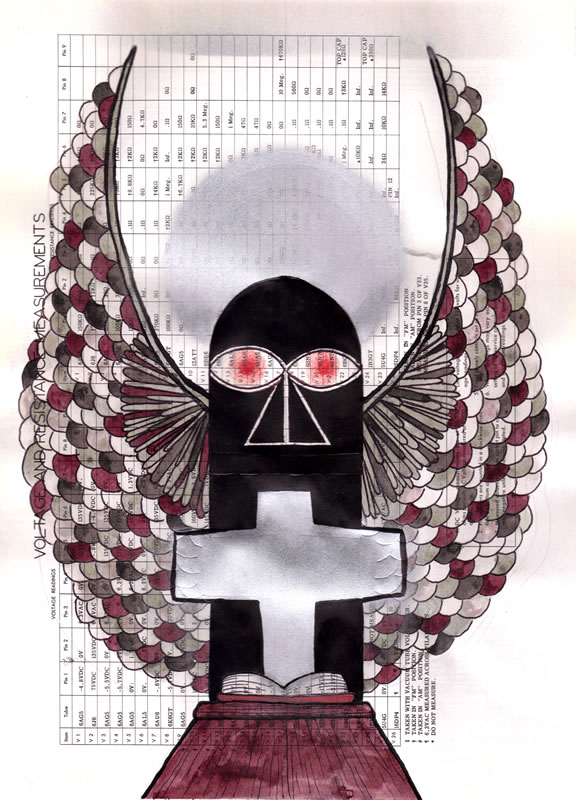
The peglike buoy figure of the water gazers in 2 returns in MK’s rendering of the “black Angel of Doom” Ishmael witnesses “beating a book” before a congregation in the “negro church” whose service he rudely interrupts then cruelly mocks before eventually finding his proper place at the Spouter Inn in New Bedford. The water gazers in 2 appear sexless and featureless apart from their beaky noses, hazy grey eyes, and multi-colored, -patterned wrappings. This canvas suggests that the figures are racialized, as this one is painted jet flat black from its smooth rounded head to the point where its tubular body vanishes behind a small brown pulpit uplifting a small book. The hazy, pointilated eyes are red, and a pair of large wings extend lifted from its sides, composed mostly of neatly layered small scallop shapes colored in various shades of maroon, grey, pink, black, and white (The wings have another texture where they meet the figure’s body: long slender U-shaped forms are colored in various shades of grey and black). A light, metallic grey spray-painted cross appears afront the black figure and a likewise painted nimbus crowns its head, framed between the uplifted wings.

The peglike figures seem to be MK’s answer to rendering the nameless landlubbers who populate the early pages of MD. This one is given prominence as the sole occupant of the canvas and by its great wings, but its most distinguishing and important feature is the one that differentiates it from the water gazers in 2: its blackness. Ishmael’s attitude (mock-revolted, dismissive) toward the congregation and pastor at the Black church is far from generous – indeed it’s dehumanizing – and MK chooses his moment on this cringeworthy page of MD to wrest some compromise between what Ishmael reports seeing and what he sees Ishmael seeing. Such compromises are fraught under the weight of US history. I’m anxious to witness how and where he chooses to grapple with illustrating Ishmael’s (and Melville’s) often racist characterizations of Black persons especially as the book goes on, having only begun myself with this “Angel of Doom” to sense the burden of (ir)responsibility that follows hard upon returning them into words. What is “doing justice” to a book like this, when it’s an injustice to some?

On the very edges of broad horizontal arms of the cross, where they extend past the tubular black body, you can make out traces of the scalloped lines composing the Angel’s wings beneath: a clue to the order in which the elements were created to compose this canvas – a detail I love.

Matt Kish
MOBY-DICK, Page 008

Title: …and beyond, a black Angel of Doom was beating a book in a pulpit.
(7.75 inches by 11 inches; ballpoint pen, colored pencil, ink and spray paint on found paper; August 13, 2009)

Every Page of Every Page of Moby-Dick, 7

8/24/21

1:11pm

7

First collage of the book, by virtue of yellowish green, rectangular cartoon affixed to the bottom of the found page (finally figured out from the printing on this page that the book being repurposed for these canvases is a systems manual for a Philco Chassis radio). The cartoon shows a man with his hand glued to a cabinet or window with another person (maybe a woman) behind, grasping his shoulders, trying to help him pry it off, the glue stretching between the man’s palm and the object’s surface: he appears panicked and pained, both appear strained. The cartoon forms a kind of band across the wrist of a rudimentary hand outlined with a medium-thick black pencil line, shaded grey, which occupies the majority of the canvas. Three irregular splotches of silver spray paint are added to the center of the canvas, representing the “few silver pieces” Ishmael retrieves from his pocket as he considers lodging options upon first arriving to wintry, tempestuous New Bedford.

Without the cartoon, the painting would register as a rather literal rendering of this page of MD compared to the canvases that have come before. The comical image of the man in a sticky situation belies the seriousness of Ishmael’s predicament – arriving to an unfamiliar place after nightfall with “little to no money in [his] purse” and facing a icy, restless night on the city street unless he finds shelter soon – but this is precisely the aptness of the collage. For all his vulnerability upon arriving to New Bedford, Ishmael casually, jokingly, even mockingly surveys his prospects before finally finding hospitality in the Spouter Inn.

MK’s illustrations are keenly attentive to the humor of MD; his choice of line often reveals his attraction to it. The line from the book that inspired this illustration is not the most overly funny line in the book up to this point, but this is one of the first overtly comical illustrations owing mainly to the element of collage.

Matt Kish
MOBY-DICK, Page 007

Title: With anxious grapnels I had sounded my pocket, and only brought up a few pieces of silver…
(7.75 inches by 11 inches; collage, colored pencil and spray paint on found paper; August 12, 2009)