Every Page of Every Page of Moby-Dick, 22

22

2:23pm

If Queequeg were made into an action figure (the true Queequeg, I mean, not that Star Wars knock-off, which nonetheless made for a legendary toy), besides featuring certain distinguishing bodily traits, he’d be reasonably expected to come packaged with several accessories – an embalmed head or a poncho maybe, his harpoon and tomahawk-pipe almost certainly – but none of the items with which Queequeg is characterized by proxy in MD would be as justifiably sealed up with him forever in a collector’s cellophane sarcophagus as Yojo, the ebony idol he worships.

10:27pm

MK paints “Yojo” before painting the figure of the idol itself; the name occupies nearly the whole of the canvas: Y O appearing in the upper half, J O just below. The letters are outlined in a brushed band of rich, gum pink, with a band of blood red tracing the outer edge of these formations, and another layer of pink beyond that, then another layer of red… the pattern repeating until the bands of color are just peaks and arcs barely showing the contour of the letters they’re shaped by as they ripple out to the margins of the canvas. In the hollow left by all these concentric bands of pink and red, the Y O / J O reveals another labeled circuitry schematic beneath the paint, save for in the middle of each O where are rounds of the gum pink. This is only the second time MK’s canvas identifies a character by a name (excluding Queequeg’s signature), and the first is the first illustration of the whole project, identifying Ishmael. There are many different ways, however, that MK registers the influence of individual words and fragments of speech in the illustrations occasioned by them. In this case, Queequeg’s idol is not named at this point in the text of MD (“Yojo” is not said until 13 chapters later), so the moniker swimming in the background of this canvas is another anachronism designed by MK, whose interest seems drawn in part by the pictorial symmetry of the name, given its arrangement on the canvas.

The figure of Yojo is formed by a rudimentary black outline in the foreground of the canvas. Its back is rounded and its apparent front quite flat, the body terminating in a short stump for a base. The head is shaped like a slightly squashed letter b, featuring two ribbed conical formations with black ovals at the tapered ends, seemingly serving for eyes. A rectangular patch with rounded edges is painted on his chest with sparsely brushed s-shaped vertical lines running along its length, like a rough-hewn wood grain raised from the boundless waters pushing out against the little body invested with the power of their god.

Maybe it’s just me, but if you cock your head to the right when viewing this canvas the two large Os in the name Yojo lose their appearance as letters and look instead like a pair of glaring red eyes, the Y and the J similar but not exactly matching underlying markings.

Matt Kish
MOBY-DICK, Page 022

Title: …he fumbled in the pockets, and produced at length a curious little deformed image with a hunch on its back, and exactly the color of a three days’ old Congo baby.
(7.75 inches by 11 inches; acrylic paint on found paper; August 27, 2009)
Every Page of Every Page of Moby-Dick, 21

9/15/21, 5:28am

21

Ishmael’s introduction to Queequeg, and the introduction of the latter into MD, consists in some 1,200 words worth of observations concerning the appearance and actions of a person who’s just walked into his own rented room at the Spouter Inn, where, unbeknownst to him, courtesy of landlord Coffin, another man is in his bed, observing him undress and prepare for sleep. 

The light by which Queequeg is observed is held in one of his hands, the rumored embalmed head in the other; he sets his candle down in the corner and begins untying the cords closing his bag of personal possessions. This is the extent of action described before Ishmael spends 200 words reporting on the appearance of the skin on the Queequeg’s face, which the former “was all eagerness” to see while the latter was turned from him, working at the bag. Apart from the initial confusion pertaining to the “large blackish looking squares” – Queequeg’s tattoos, which Ishmael initially mistakes for surgical “sticking-plasters” – the tone of the skin around these “stains” particularly disturbs him: it’s an “unearthly complexion,” he reports, “of a dark purplish, yellow color.” Ishmael’s overfull head at least contains some vague precedent for regarding tattoos as something under the sun, but for Queequeg’s skin tone he has no preconception: “I never heard of a hot sun’s tanning a white man into a purplish yellow one.” Of course, the presumption he’s made – Ishmael’s prejudice – is that Queequeg is “a white man,” that Coffin wouldn’t have paired him with a non-white man for a bedfellow (despite the landlord having specified that he’s a “dark complexioned chap”). 

The only figurative language registered in the whole of this lengthy literal report on Queequeg’s appearance and behavior upon entering his room is one simile meant to convey the speed with which all these considerations and wonderments passed through Ishmael’s mind: “like lightning.” The next time a simile is registered occurs after Queequeg has extracted his “sort of tomahawk” out of his bag, stowed his unsold head in it, removed his hat, and turned again so Ishmael can see the “scalp-knot” upon his forehead, all he has for hair: “His bald purplish head looked now looked for all the world like a mildewed skull.”

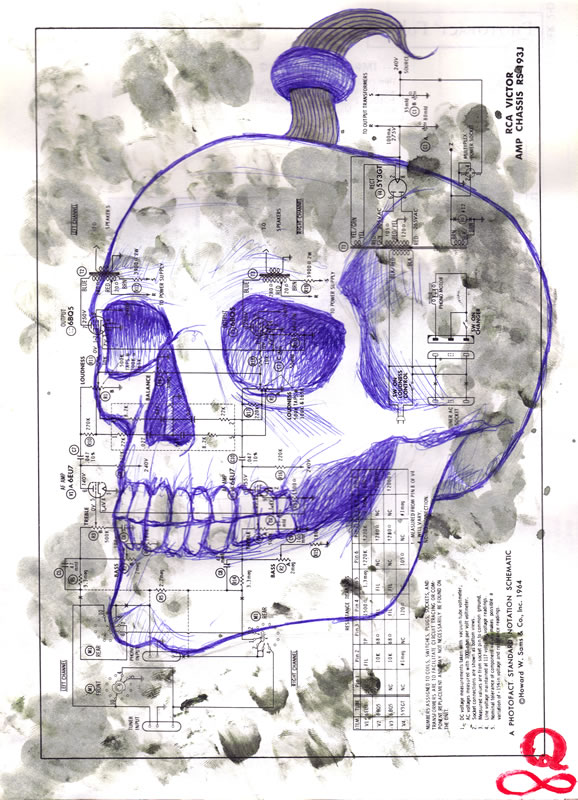
The event of language that MK chooses to illustrate from this page of MD is a disturbing one whereby Ishmael figuratively flays the offending skin off the face he’s just spent an intricate paragraph trying to account for. The death’s head collaged onto the body of the black yarn of the nightmarish harpooneer in 18 is here hand drawn in indigo ink with osteological exactness. The skull is sketched large, occupying the majority of the found page (now, again, a schematic from a radio manual: this one for an RCA Victor amp chassis); if face it had, it would be facing the left margin of the page. Daubs of greyish black ink are concentrated along the back of the skull and spread outward from its outline into the upper and lower left corners of the canvas. Only two features of the canvas render the skull identifiable as Queequeg. MK includes a thick, neatly bound “scalp-knot” of hair atop the skull – an uncanny sign of vitality and health on this otherwise lifeless thing – and, in the lower left corner, the Queequeg signature: a boldly inked capital Q above an infinity band, in red.

Previously, after my attempt to account for the nightmarish vision of the black yarn of a harpooneer in 19, which Ishmael carries with him to bed courtesy of landlord Coffin, when publishing that writing on my blog, I decided not to tag the post with the name “Queequeg.” I didn’t want the archival function of the tag to index that monstrous vision beneath that name. With this illustration, I have a similar reluctance, but the presence of the Queequeg signature upon this canvas seems to decide for me that this illustration and my writing about it will be so tagged. I don’t want it to be. This, too, I believe, is a conspiratorial vision of Queequeg: not an illustration of him so much as how he is seen to be literally skinned alive by the naive, prejudiced, dangerous gaze of the seemingly harmless person hiding terrified in the bed where the pair will spend the next few days cozying up and becoming best friends.

Matt Kish
MOBY-DICK, Page 021

Title: His bald purplish head now looked for all the world like a mildewed skull.
(7.75 inches by 11 inches; acrylic paint and ballpoint pen on found paper; August 26, 2009)

Every Page of Every Page of Moby-Dick, 20

20

5:41pm

MK’s first illustration of Queequeg is a portrait of the character as he (a veteran reader) sees the beloved harpooneer first entering the door to his room in the Spouter Inn, not as Ishmael reports seeing him. In this respect it’s a rather radical departure from any of the illustrations that have come before it or those that immediately follow it.

When Ishmael first sees Queequeg he’s still got that nightmare of a tangled black yarn of a bloodthirsty deadheader on the brain, and Queequeg “himself” – one of the most fully developed and memorable characters of the early portions of MD – only becomes known in bits and pieces. Like the painting in the entryway to the Spouter Inn, he’s only accessories, parts, and individual features – decontextualized fragments seen, heard, and felt – before becoming a fully-fledged personage to Ishmael, or to the reader. Indeed, Ishmael introduces Queequeg into the book almost precisely as he does the harpooneer’s poncho: as something he can’t quite recognize but nonetheless brazenly examines and meticulously describes. In this first portrait of the “infernal head-peddler” Queequeg is seen wearing the poncho so laboriously and lovingly drawn by MK in the illustration previous (reproduced here in all its wonderful detail), and since we know that poncho to have been left in the room while he was out on his errand, this should be the first clue that MK is deliberately stepping out of the seductive, overwhelmed reporting of Ishmael and making his own vision of Queequeg known, in its own time.

8:01pm

At the same time, some of the striking first impressions that overwhelm Ishmael’s faculty to recognize Queequeg seem to influence MK’s more developed and contextualized vision of the character: especially, Queequeg’s tattooing. The first sight of Queequeg’s face Ishmael gets in MD is conspicuously registered as one of those moments where the narrator’s confusion and, in this case, alarmed wonderment is passed on to the reader: “good heavens! what a sight! Such a face! It was of a dark purplish, yellow color, here and there stuck over with large, blackish looking squares.” Ishmael concocts a theory that the dark squares are “sticking-patches,” that the harpooneer has been in a dreadful fight and has had to see a surgeon, before realizing they’re tattoos. MK’s first rendering of this face not only differs in terms of the colors chosen to echo the markings – in MK’s illustration they’re resolutely blue – nor in their shape – here they’re drawn as a collection of overlapping scales, each comprised of concentric scallop-shaped lines rather than as squares – but, more importantly, the mood the figure of Queequeg strikes on MK’s canvas is serene and gentle, not threatening. The figure is stooped, the ovular head hung forward atop the steeply sloped body.

Queequeg’s tall harpoon stands prominently to the left of the figure occupying the whole left margin of the canvas, black at the handle and awash in red, which is also flecked across the top left quadrant of the canvas: another anachronism from this page of MD, since the harpoon was left in the room along with the poncho. There are two other distinguishing features of this canvas, however, that should indicate that this is a more deliberate, contextualized portrait of Queequeg than Ishmael provides at this point in the book.

  1. The choice of found page on which the illustration is made features a legible map of Pacific isles, situating the character in more of a concrete geographic and cultural locale than he ever is in MD; 
  2. In the upper right hand corner of the canvas there’s inked an uppercase thickly lettered Q, in red, just above a thinly drawn infinity symbol. This pair of marks becomes a signature of sorts, as we’ll see inspired by Queequeg’s own, which is featured on many of the canvases depicting the harpooneer. 

In comparison to the abject terror the appearance of Queequeg first instills in Ishmael, the only vaguely ominous feature of the figure MK illustrates is its lidless eyes, their red pupils pointilated about the edges, giving them a glaring, strained, and hazy look. 

I’ve ventured before the surmise that red eyes in MK’s illustrations of MD indicate a character in extremity, and the only theory that will answer for what extremity Queequeg might be said to be in – this character who never cringed and never knew a creditor – suggests that those blue markings shown all over as his face do not represent Queequeg’s artificial bodily markings as much as his natural bodily medium that it will be the arc of MK’s illustrations to render (back) unto infinity.

Matt Kish
MOBY-DICK, Page 020

Title: Lord save me, thinks I, that must be the harpooneer, the infernal head-peddler.
(8.5 inches by 11 inches; acrylic paint, ink and marker on found paper; August 25, 2009)

Every Page of Every Page of Moby-Dick, 19

19

9/12/21, 7:45am

After landlord Coffin has deposited Ishmael in the harpooneer’s room with assurances of the spaciousness of the retired conjugal bed and orders to make himself at home, Ishmael scrutinizes the space and notes the harpooneer’s few personal effects deposited there: a large seaman’s bag, a tall harpoon, and a heavy shaggy textile that Ishmael can only liken to a “door mat,” which lays upon the “crazy old sea chest” conspicuously furnishing the room. Ishmael holds the article to the light and smells it, noticing some ornamental “tags” around its perimeter and a hole or slit in its middle that reveals it to be a garment, some kind of poncho. Ishmael pulls the garment over his head to examine his appearance in a piece of mirror and only registers its dampness before his reflection sends him tearing out of the poncho so fast he strains his neck.

As Ishmael’s observations upon first entering the Spouter Inn prompted MK’s illustrations of the dingy, indistinct painting and Nat Swain’s storied lance, Ishmael’s survey of his shared room prompts another still-life. The harpooneer’s poncho is drawn as if spread flat upon another page from the sewing instruction guide, this one featuring a list of the book’s contents pertaining to “Necklines & Collars.” Those words, printed in large gold lettering along the right margin of the rotated page are only partially obscured by the specimen of wonderfully intricate black inkwork. One corner of the poncho is shown on the canvas, formed by heavily drawn perimeter lines that extend from the upper third of the left margin and near the far right corner of the lower margin. 20+ tassels sprawl from the delicately scalloped edges, each holding a narrow, pointed toothlike shape with a black band about its middle. Within this defined area of the canvas MK draws a tightly compacted herringbone pattern consisting of 77 individual columns of tiny, slanted lines. (The columns are mostly oriented at roughly a 15 degree angle off the vertical axis of the canvas.) The pattern isn’t perfectly uniform, but broken up at intervals by columns that veer off at diagonal angles for some length before joining into others. Another variation in the pattern of penwork comprising the textile are groupings of white-outlined block shapes. 

11:58am

The veering columns of herringbone linework often converge around these patches of white blocks, creating the visual effect of scattered darns in the textile’s surface, indicating age or use. The slit at the center of the poncho is rendered as a narrow black rectangle in the lower left quadrant of the canvas, extending from its bottom edge toward its left margin, surrounded by a neat network of lines running perpendicular to the black rectangle’s sides and surrounded by a white rectangular band for a hem. Some of the printed lettering of the table of contents of “Necklines & Collars” is still visible in this white rectangular frame and some of the white-block darn spots as well.

Perhaps the only consideration that can deepen the striking visual impression of this still-life is the time and patience it took MK to create it. All the more impressive considering that the poncho is all but absent from the text of MD after this moment but becomes a regular feature of MK’s many illustrations of the harpooneer that follow, meaning that almost every time he drew Queequeg, there was a significant concentration of time and energy dedicated to the intricate herringbone textile he sports for outerwear. Perhaps impossible to capture from the perspective and style in which the textile is rendered here is its dampness. In the world of the book created by MK, what Ishmael takes to be moisture resulting from the poncho being worn “of a rainy day” is rather a residue of the body it contains.

Matt Kish
MOBY-DICK, Page 019

Title: I can compare it to nothing but a large door mat, ornamented at the edges with little tinkling tags something like the stained porcupine quills round an Indian moccasin. There was a hole or slit in the middle of this mat, as you see the same in South American ponchos.
(8.5 inches by 10 inches; ink on found paper; August 23, 2009)

Every Page of Every Page of Moby-Dick, 18

18

Even after Coffin clarifies matters for Ishmael about the late nighttime activities of his promised bedmate, Ishmael is determined to imagine the worst: “‘Depend upon it, landlord, that harpooneer is a dangerous man.’” This time he justifies his prejudice on religious grounds, in such a way that (really, as such a proudly learned person) he should’ve figured out by now what sort of person the harpooneer is: what sort of person, he wonders to himself (as if in real time), spends the earliest hours of a Sabbath day involved in such a heathanish business as selling embalmed heads?

9/10/21, 9:05pm

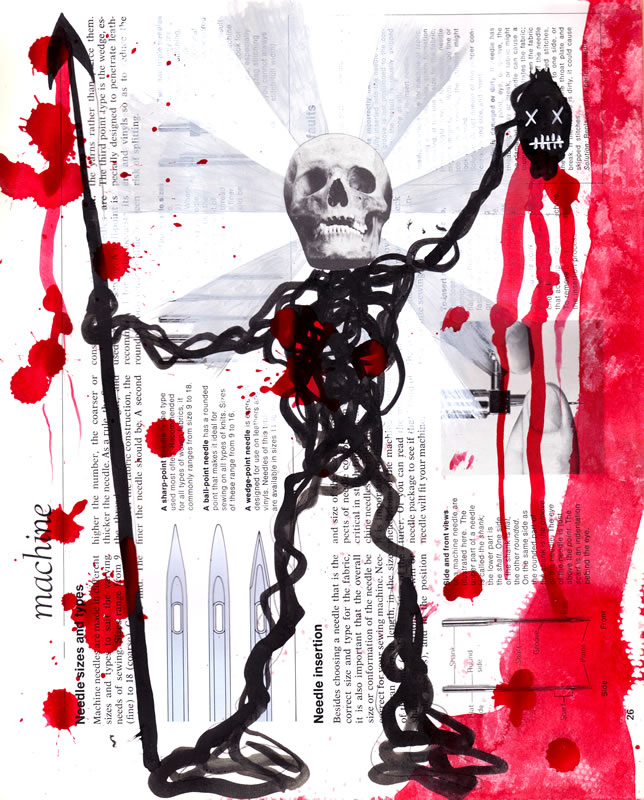
MK’s illustration of Ishmael’s nightmarish vision of the harpooneer features prominently another death head – not drawn but collaged into the middle of the upper third of the canvas. Surrounding the black-and-white cutout of a  mandibled skull, is a broad, vague nimbus of white paint (barely discernible over the found page) with intervaled starburst blocks of grey. The feature is subtle but draws the eye to the death’s head almost as readily as the macabre array of red ink dropped, splattered, spilled and daubed about the canvas, most conspicuously on the margins. Owing to these most striking features of the illustration the eye can easily pass over as mimetic the tangle of black brush strokes twisted and spiralized into the approximate silhouette of the torso and limbs of a person, broad coiled ropes of black paint for feet. Clasped in a small, hooked loop at the end of a tendril-like braid for a right arm, a long black harpoon is painted, standing taller than the figure itself, red ink dripped and running from behind its spade-shaped head. Uplifted in the other twisted vine of an arm is a small black oblong shape (the offending “‘balmed head”) with white Xs for eyes and a horizontal white spine for a mouth. The figure is the horrible embodiment of the yarn Coffin has been spinning Ishmael about the harpooner. 

The question is: why does Ishmael persist in this nightmarish fantasy of the harpooneer even after Coffin more plainly explains the reason he’s out so late; what danger does he still pose? MK’s illustration, like the one of the barman Jonah’s poison tumbler, suggests death is at the bottom of it; only here, as with “the black Angel of Doom,” a shaded nimbus serves for the crown. The color chosen to paint the tangled yarn body – besides complimenting the black-and-white scheme that makes the drops, drips, splatters, and spills of red ink on the canvas scream bloody murder – serves as a fair reminder of the only information Ishmael has actually been given about the harpooneer besides the head peddling business: he’s “‘dark complexioned.’” This illustration is one of a monstrous black Other, truly more of a danger to any person the fantasy would be projected on than to the one doing the bad dreaming. As far as Coffin is concerned, as he rejoins before setting off to tuck Ishmael in, the man is civilized enough by the standards of the Spouter Inn: “‘He pays reg’lar.’” More than Ishmael could promise.

Matt Kish
MOBY-DICK, Page 018

Title: “Depend upon it, landlord, that harpooneer is a dangerous man.”
(8.5 inches by 10.5 inches; acrylic paint, collage and ink on found paper; August 23, 2009)

Every Page of Every Page of Moby-Dick, 17

17

9/9/21, 10:00am

Ishmael’s dialogue with Peter Coffin, landlord of the Spouter Inn, is his first sustained engagement with another character in MD. Given the earnest learnedness (or learned earnestness) with which Ishmael has represented himself up to this point, it’s a relief to read someone freely sporting with him.

Coffin has a great deal of fun teasing Ishmael, especially when it comes to pairing him with a pagan harpooneer for a bedmate. Given his proprietorship of a low-end lodging establishment in the then whaling capital of the world, New Bedford, teasing Ishmael can be chalked up to a form of hazing that one can imagine him not infrequently doling out to those customers who seem particularly out of their element in his Spouter Inn. “Spouter,” following the usage in Dana’s Two Years Before the Mast, is synonymous with whalers and whalecraft; prior to this adoption, “spouter” was a common seaman’s moniker for a (south seas) whale. While Ishmael tries to rebuke Coffin’s gibes – assuring him: “‘I’m not green.’” – the landlord knows he’s never been shown a face like Queequeg’s. As the light of the next morning will reveal to Ishmael, however, he’s a less common breed in the streets of New Bedford than the “‘dark complexioned chap’” out in the bitter cold of a winter’s night trying to sell his last “‘‘balmed New Zealand head.’” Such “‘curios’” are not wholly uncommon sights in Coffin’s world, and he knows Ishmael doesn’t have the experience to fill in the gaps for himself about what might be meant by the harpooneer being unable to sell his head, so he doles out just enough discourse to keep Ishmael guessing and panicked – never lying precisely, but never giving the whole truth until he’s worked Ishmael into a “towering rage” and the latter has approached him coldly and wildly threatened “‘criminal prosecution.’” Coffin releases Ishmael from his yarn gently and puts him to bed.

MK’s illustrates a moment in this exchange prior to Coffin clearing up the matter of Queequeg being out late peddling the last of his curios (picked up on his last voyage to sell at port for profit before shipping out again). “…‘ain’t there too many heads in the world?’” Coffin wonders aloud when Ishmael seems affronted by the idea of selling one. On a found page featuring mostly text itemizing various sorts of hand needles, there are more than 80 different bodiless heads painted, inked, and sketched in a multitude of shapes, sizes, and colors. The heads’ eyes are their most prominent feature: some are anthropomorphic, some resemble the vizor-eye of Bulkington (in 14), some the balene-band of the young fellow (in 13), some are a series of dots or mere lines. Some of the heads are drawn rudimentarily – like the inverted yellow triangle with a line across its lower vertex for a mouth and two dashes below its uppermost, longest edge for eyes – and some feature abstract designs and markings. The only distinct feature of a red, tombstone-shaped head with two white dots for eyes is a golden cross with a four smaller lines extending from its center on the diagonals, like a Christmas star; the shape of this marking mimics the arrangement of the 80+ heads on the canvas as a whole. The heads are concentrated, converging and overlapping most along the X and Y-axes of the canvas, larger in size and greater in detail toward its center and smaller toward its margins, giving the illustration the vague look of a data visualization.

6:36pm

After Ishmael gets fed up with Coffin’s “‘mystifying and most exasperating stories’” regarding his prospective bedmate and threatens legal action on his host, given that the only logical conclusion he is able to come to with respect to the head-peddling harpooneer is that he’s mad and that Coffin would be therefore criminally liable if he forces Ishmael to share a room with him – after presenting this logic to the landlord in the span of two hundred words – Coffin replies (I’m paraphrasing): “that’s a whole lot of talk for a man who farts like everyone else.” He then provides Ishmael the context he requires to understand the dialogue he’s been having, and a subtext of his query about there being too many heads in the world comes into focus: “Here’s one head too many, or too much head for one head to hold. In all my years, never such a spouter in the Spouter!”

Matt Kish
MOBY-DICK, Page 017

Title: “…ain’t there too many heads in the world?”
(8.5 inches by 10.5 inches; acrylic paint, ballpoint pen, ink and pencil on found paper; August 22, 2009)

Every Page of Every Page of Moby-Dick, 16

16

9/8/21, 10:30pm

A found page showing a series of diagrams and minimal instructions about how to pattern and stitch a pencil is backdrop to a simple and funny bit of pop art heeding Ishmael’s anxiety about the harpooneer’s potential retaliation were he to go forward with his plan to lock the man out of his room for the night.

A jagged frame – resembling the starburst shape behind a comic POW! – is formed by a series of irregular peaks outlined in red extending from the margins of the canvas, painted white and pockmarked over with red dots. Within this frame, drawn large over the pencil craft instructions and shaded so they’re still visible beneath, is a frontal view of a large, block-like fist. The four fingers of this apparent right jab are formed by a rectangle tilted to one side, outlined in black, with three parallel and equally spaced lines extending from the lower edge of the rectangle three quarters of the way to its top; a smaller rectangle drawn abut the larger one on the far right side connotes the thumb, and a semicircle is drawn and centered on its top, evidently the only visible bit of the forearm or shoulder of the limb throwing the punch at the viewer’s face. The piece is a rather notable stylistic departure from any of the canvases that have come before it (though it resembles somewhat the wrecking cube fists of the invisible police officer of the fates in 5), and it is a good reminder that MK’s every illustration need not conform to or establish a pattern. A pattern can make a pencil, but the pencil need not reciprocate.  

The whole point here is to show something you don’t see coming. At the same time, the illustration is ironic, since Ishmael does see it coming. MK’s penchant for MD’s humor motivates his choice of line from this page to draw, where Ishmael all but names the genre of illustration it inspires: “so soon as I popped out of the room…” Pop! Pow! Wow! A fist! A first. Surely not the last.

Matt Kish
MOBY-DICK, Page 016

Title: For who could tell but what the next morning, so soon as I popped out of the room, the harpooneer might be standing in the entry, all ready to knock me down!
(8.5 inches by 10.5 inches; acrylic paint and ink on found paper; August 19, 2009)

Every Page of Every Page of Moby-Dick, 15

15

9/6/21, 2:12pm

Ishmael is memorably, insufferably reluctant about the prospect of sharing a bed when he finds no private room available at the Spouter Inn. The landlord Coffin suggests he share a bed with a harpooneer, adding that Ishmael ought to be okay with that sort of thing if he’s going a-whaling, and our narrator warily assents to the plan, on condition that there’s nothing “objectionable” about the harpooneer. A bit later, after Coffin teases that the harpooneer is a “‘dark complexioned chap’” who only eats rare steaks, Ishmael’s misgivings grow. Just before reporting his first impression of Bulkington, he seems content to share a bed with the harpooneer on condition that the latter undress and get under the covers first (… ?), but then after the Bulkington business he reveals that he’d hatched another plan already, that is, after the landlord’s “diabolical” innuendos reported prior: to sleep on the hard, knobby bench in the inn’s communal space. Coffin comically accommodates this request for a bit before Ishmael tests the bench, deems it unsuitable, and then starts hatching still other plans for sleeping comfortably at the Spouter Inn. He first entertains a notion of beating the harpooneer to his own reserved room and locking him out of it for the night and only dismisses it owing to the threat of the harpooneer’s presumed vengeance; only then does he consider the possibility that he’s being a bit prejudiced and should meet the man before judging his fitness for a bedfellow.

Another meticulously reported line of pained reasoning occurs during Ishmael’s flip-flopping, just before he tells Coffin that he’d prefer the bench for a bed, which he ends up rejecting. It runs thus:

  1. Point: No one really likes sleeping two to a bed; sub-point: even if the bedfellow is a family member the prospect is undesirable, to say nothing of a complete stranger in an unfamiliar place;
  2. Point: Sailors don’t have to be used to that sort of thing as a rule; sub-point: certain they must share a sleeping quarters, but every man expects to have his own bed (or hammock) and blanket.

MK’s choice of line to illustrate from this page, occupied almost entirely by Ishmael’s self-sophistry about having to share a bed – which concludes by likening sleeping between sheets with another person to sharing a skin – occurs between point and subpoint 1. The canvas is created on another found page from the sewing instruction guide, this one about how to properly cut out pattern pieces. In the lower-left quadrant a partial view of a rectangular bed is outlined in black ink and colored white, except for the blanket which is painted red with orange tubing. The rounded head of a familiar peglike figure is visible sticking out from under the blanket – colored grey with a double-bowed black line stretching across its top for closed eyes, its bisected triangle of a nose half covered by the blanket.

The most striking element of the canvas is the beam of prismed color drawn entering the canvas from the lower third of the far left margin, running directly across it, abutt the head of the peglike figure, and recommencing on the other side of it until this rainbow road meets the edge of the bed, where the individual bands of color – from bottom to top: red, orange, yellow, green, blue, violet, red again – peel off and blossom into a bouquet of shaded natural textures and shapes. The orange and green bands curl downward to form spirals, between which the yellow band expands like a tunnel of light and exits the right margin of the canvas. Hung center canvas is a globular frond suspended like a pendant from the blue band that has shot up on a slight wavy course and bent back. The violet band reaches out toward the edge of the canvas, twisting like a vine. The uppermost red band swells into a compacted wave, and the lowermost red band looks like an outline of this wave spilt upon the sand. Disconnected from the beam of prismed color itself, as if grown out of their blooming on the right side of the canvas, furthest from the sleeping peglike figure in the bed, is a blue shaded gord-shape with a hole in its side out of which grows pair of green tendrils winding their way toward the bottom of the canvas, one of which has produced a palmate leaf.

The illustration evokes serenity and captures the experience of (serenely) dreaming, especially when the sleeping peglike figure is regarded as a sort of everyperson, befitting the generalization Ishmael makes in the line that gives this canvas its title: “people like to be private when they sleep.” Here, perhaps, is the beau ideal of restfulness driving Ishmael’s inexplicable fussiness and indecision about the sleeping accommodations available to him at an inn where he has little to no money to spend. To achieve it, Ishmael thinks, one has to be alone. 

Indeed, this canvas is equally if not more interesting to view as a portrait or self-portrait of Ishmael himself than as an anonymous sleeping everyperson. The beam of prismed light that enters the peghead all neatly composed only to explode into a burst of forms and shapes on the other side, after all, recalls the rainbow road bearing Ishmael’s name that cuts through the jaundiced clouds overhanging the baghead on canvas 1. In spite of all his seeming self possession and self awareness, in Loomings Ishmael gives a slew of sometimes incompatible reasons for going a-whaling: to cure myself, to (not) kill myself, because I have no money, because I have no ties that interest me ashore, because it was fated, and that fate was enforced. His logic is similarly tortured when it comes to sharing a bed.

9:16pm

Ishmael’s train of discourse is less like a rainbow road than a rainbow rail, running simultaneously along not one or even two but a spectrum of lines of thought, each having its own idiomatic hue and flowering into shapes and forms unto themselves. It’s a private sleep indeed – a consummation devoutly to be wished – that can bring all these flowerings into one illustrative composition. Pattern-making helps.

Matt Kish
MOBY-DICK, Page 015

Title: I don’t know how it is, but people like to be private when they are sleeping.
(8.5 inches by 10.5 inches; acrylic paint, colored pencil and ink on found paper; August 19, 2009)

Every Page of Every Page of Moby-Dick, 14

9/5/21, 7:19am

14

Bulkington – Ishmael’s soon-to-be shipmate whose “apotheosis” punctuates the poetic rhapsody marking the Pequod’s passage from harbor to open ocean in The Lee Shore – is first spotted by our narrator in the Spouter Inn. In this canvas MK spots him first spotting this specimen whaleman.

In MD, Bulkington is described as dark complexioned – “face… deeply brown and burnt” – phrasing which has lent support to interpretations of him as dark-skinned by birth and sunbaked by his career asea. Melville’s text does not identify this brief character as Black so unambiguously as those inhabitants of the “negro church” Ishmael trips into and degrades in The Carpet-bag, but if Bulkington is Black, then he’s only the second individual Black person described in their individuality in MD, after the “black Angel of Doom.” In MK’s illustrations, Bulkington’s is the third black face, after the Angel of Doom and the “young fellow” illustrated just prior in 13. 

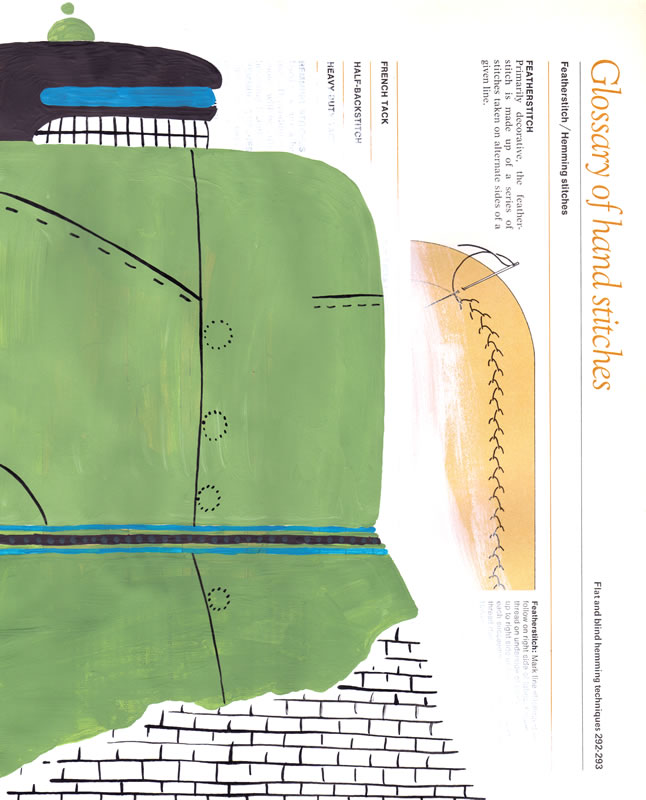
Bulkington’s head – painted small in the upper-left corner of the canvas, facing right, with an undersized, tufted pea green sailor’s cap perched aloft – is not given the elongated peglike appearance of a landsman but appears rather like that shape hammered down to a stump, a brow-like formation overhanging in the silhouette of his face at the base of which another tunnel-like mouth is filled-in with two even rows of shock-white blocks for teeth. The prominence of these teeth is a detail from Ishmael’s description of Bulkington that, notably, does not derive from the titular quote for this canvas; another such detail is reflected in MK’s representation of Bulkington’s eyes as a single elongated band of deep blue, like a helmet’s vizor rendered fluid. In MD, Bulkington’s eyes are described as shadowed, and “floating” in them Ishmael espies “reminiscences that did not seem to bring him [Bulkington] much joy” before he quietly retreats from the raucous society of his fellow, recently-landed shipmates, and they go out into the dark streets hollering after him. In MK’s illustration, Bulkington’s brawn and bulk are given a more enduring presence.

2:17pm

Bulkington’s “coffer-dam” of a chest is the most prominent feature of his physical characterization in this canvas, occupying more than the whole left half of the found page upon which it’s painted: the first sheet of a “Glossary of hand stitches,” rotated 90 degrees right. His pea green monkey jacket – markedly out of proportion to his small, black head – is geometrically shaped with a long sloping corner forming the shoulder, which mimics the contour and placement of the yellow-gold illustration of a featherstitch still visible on the found page just to the right. The billowing visual effect of Bulkington’s jacket is buttressed by two more details of the canvas: 1) the topmost part of the green jacket is painted so as to just overlap the lower row of white teeth, making the figure appear neckless or as if viewed from below, and 2) a waist-belt comprised of a grey-black band sandwiched between two thin lines of blue paint, below which the jacket appears to angle out sharply. Bulkington is swole, but in a fashion rather heavy and static than airy. Indeed, MK adds a feature to the canvas to concretize this bulk: where the found page has been painted over white to accommodate the subject, from below the waving tapered front hem of the monkey jacket, a brick wall extends composed of neatly patterned black lines.

The way MK illustrates him, it would be a wonder for Bulkington to slip from a crowded room unseen, much less to fall into water only to evaporate into thin air. A coffer-dam is a structure designed to enclose and contain great water pressure while submerged. What force, then, could break this body and release the native element therein – brimming just below its surface, as seen by that narrow channel of a vizor-eye – so as to transmogrify it to air? Spoiler: Moby Dick.

Matt Kish
MOBY-DICK, Page 014

Title: He stood a full six feet in height, with noble shoulders, and a chest like a coffer-dam. I have seldom seen such brawn in a man.
(8.5 inches by 10.5 inches; acrylic paint and ink on found paper; August 19, 2009)

Every Page of Every Page of Moby-Dick, 13

13

When Ishmael sits down to a late supper in the frigid Spouter Inn, he and a number of sailors are obliged to button up their coats and hold teacups to their lips to supplement the unwarming glow of two cheap candles upon the table. The inhospitable temperature of the Inn is juxtaposed to the bounty they’re served for the meal: not only meat and potatoes but “dumplings… good heavens! dumplings,” Ishmael reports in that voice designed to replicate the pleasant surprise. A “young fellow” among the huddle at the table sets to eating these dumplings ravenously, prompting landlord Coffin to caution him about disturbing his dreams.

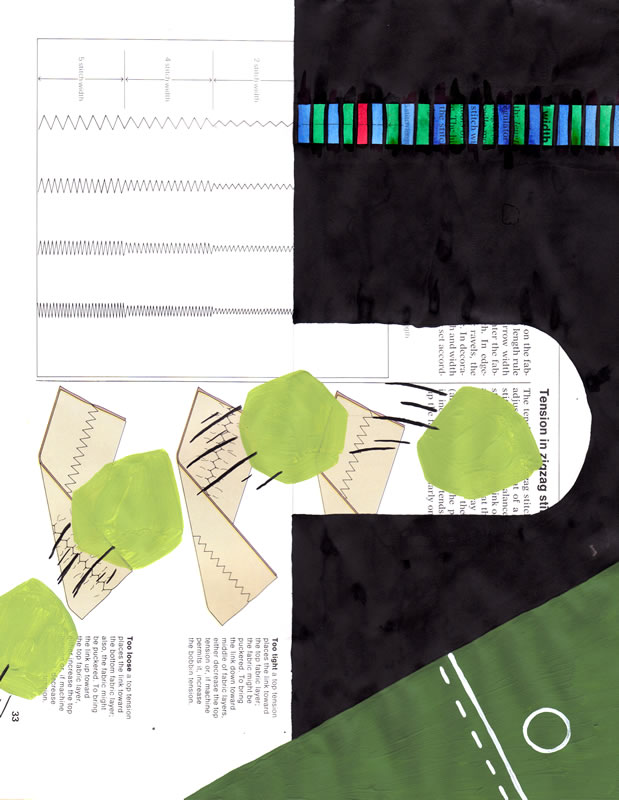
MK illustrates these rapidly consumed dumplings as four roughly formed pea-green balls – evenly spaced apart, each trailed by multiple thin black hash marks depicting motion – arching their way from the lower left corner of the canvas to its middle-right, where some have hurtled into a tunnel shaped into a flat black wall dominating the right side of the canvas. Apart from the context provided by the titular quotation from MD, only two minimal, colored features aid the impression that this is the young fellow’s face the green balls are disappearing into. Overlaying the black form, aligned in the lower-right corner of the canvas, a forest-green triangle is bisected by two parallel white lines (one solid and one dashed, like striping on a two-lane highway) and a white-outlined circle to the right of these lines: the seam and a button of the young fellow’s “box coat.” Near the top of the canvas, a narrow multi-colored balene band extends from one edge of the black wall-like form to the edge of the canvas in alternating blocks of green and blue, save for one block of red so placed as to give the figure a greedy aperture.

This is a relatively simple canvas depicting a simple moment of paternalistic humor in MD, but there are several significant movements happening here in MK’s enterprise (besides the arch of the dumplings): 

  1. The silhouette chosen to represent the face of the young fellow suggests MK interprets this character as a landlubber, since it recalls the peglike form of the water gazers in 2 and the “black Angel of Doom” in 8; this interpretation is supported by the textual detail that the young fellow is dressed in a “box coat” rather than a “monkey jacket” like the sailors at the table wear (and apparently Ishmael, too), which is shorter in length so as not to catch in the wind.
  2. MK’s attentiveness to what the characters are wearing in MD is being advertised by the shift in this canvas of one source of found pages to another. Up to this point every illustration has been created upon a page from a radio systems manual. This illustration is painted on a page from a sewing instruction book, turned on its side. A black-and-white diagram comparing four different types of stitch is left exposed in the upper-left quadrant of the canvas, and about the middle a series of beige illustrations shows the correct way to sew a suture. In fact, MK embraces this series of diagrammed folded seams – from left to right: too loose, too tight, just right – to aid in the effect of the dumplings’ trajectory into the young fellow’s hatch.

10:30pm

  1. We will see a handful more of these peglike figures before the Pequod sets sail, but this is the only remaining form of this type that is imbued with natural elements and textures in a fashion similar to the more prominent seafaring characters MK knows to be shortly arriving to the book. These Elementals will be discussed in their time, but the “young fellow” addressing himself to dumplings in the Spouter Inn is in transitional state, a hybrid figure. He wears the trappings of a landlubber: the box coat and buoy-peg silhouette, but his head is oped to or by the hues of the sea. The natural texture of the balene band that makes a power-stache on the archetypal captain commanding “GET!” (in 4) and a frown upon the geometric face of “the invisible police officer of the fates” that bullied Ishmael into whaling (in 5) serves the young fellow for eyes. A fresh experience asea is to come or perhaps just past, an experience before or behind that of Ishmael, who for his part doesn’t give the young fellow a second passing glance.
  2. The solitary red rectangle interrupting the blue-green pattern of the young fellow’s balene band, placed so as to suggest an eye, provides a clue to interpreting the red eyes of a figure that’s been haunting me – the black Angel of Doom – and one very prominent and important seafaring character MK knows to be shortly arriving to the Spouter Inn (and into MD), who is nearly always illustrated with red, pointilated pupils for eyes like those staring out of the canvas in 8 – Queequeg. In MK’s illustrations red eyes betoken a character in extremity: for the young fellow, his extremity is simple, albeit voracious hunger (“Whatcha doing?” “Eating!”). The extremity of the “black Angel of Doom” is harder to articulate, being that of a whole individual life in extreme which also shoulders the extremeness of a whole people in extremity, striving to acknowledge each of those individual extremities, and delivering them all faith. The single red hungry eye of this young fellow calls me to look back with a more sensitive and sympathetic eye on MK’s “black Angel of Doom” and quickens my anticipation of eyes I know to be awaiting me ahead.

This canvas made out of a page about how to sew sutures is itself a suture. In lightheartedly illustrating the direful manner in which this young fellow addressed himself to dumplings, MK had his own lee shore.

Matt Kish
MOBY-DICK, Page 013

Title: One young fellow in a green box coat, addressed himself to these dumplings in a most direful manner.
(8.5 inches by 10.5 inches; acrylic paint and ink on found paper; August 18, 2009)